Always Coco
Turning Sparkle into Sales: A Global-Ready Shopify Store for AlwaysCoco








About Our Client
AlwaysCoco
- IndustryLuxury Fine Jewelry (Custom & Ready-to-Wear)
- RegionUnited States
- PlatformShopify
- Delivery3 months
AlwaysCoco is a US-based luxury fine jewelry brand specializing in made-to-order and customizable pieces. The catalog includes complex configurations across materials, gemstone types, and sizing, requiring precise product representation.
As a high-consideration purchase brand, it depends heavily on clarity, trust, and seamless product confi guration to drive conversions.
Project Overview
Rebuilding Shopify For Complex Jewelry Configurations
AlwaysCoco’s existing Shopify store was not built to handle complex product configurations. This exposed limitations in Shopify’s 100-variant limit, leading to fragmented and inconsistent product configurations. Product options such as material, size, and gemstone type were inconsistently structured, making it difficult for users to compare variations clearly.
It also revealed the absence of a standardized product data model built on structured metafields and dynamic sources. This created a confusing shopping experience, particularly for international users navigating multiple product configurations. As a result, the store faced reduced user confidence and a disrupted conversion flow.
Digisoft Solution was engaged to rebuild the Shopify architecture with a focus on structured variant handling, improved product clarity, and a more consistent end-to-end buying journey across regions.
The Concept
Metafield-Driven Architecture With Dual Purchase & Inquiry Flows
The AlwaysCoco storefront was engineered using a metafield-driven data architecture and Liquid-based conditionals. It conditionally renders product logic using Liquid (server-side) and JavaScript (client-side), enabling dynamic storefront behavior.
A unified product structure was implemented to standardize how attributes such as material, size, gemstone type, and design are presented. This ensures every product follows a consistent information hierarchy, enabling easier comparison and reducing decision friction.
The system enables region-based currency display and pricing rules via Shopify Markets configuration and localized price rendering. High-value custom pieces trigger an inquiry flow, while ready-to-wear jewelry remains directly purchasable.
Navigation and product discovery were streamlined through a simplified collection structure, reducing unnecessary steps between browsing and product selection. The overall design and layout system prioritizes product clarity and maintains a consistent experience across desktop, tablet, and mobile devices.
Key Challenges Addressed
Shopify Limits Met With Structured Product Logic
Limited Support for Custom Purchase Flows
Shopify’s native product model is designed around a single checkout-driven purchase flow. This restricts the ability to implement alternative interaction paths, such as inquiry-based actions, which are often required for customizable, high-consideration products.
Absence of Dual-State Product Architecture
The platform did not support multiple interaction states within a single product structure. This limits the ability to clearly distinguish between purchasable products and inquiry-based products, especially when handling variant-level complexity.
Inconsistent User Experience Across Product Types
Combining checkout-driven and inquiry-driven products resulted in fragmented, inconsistent user journeys. This reduces clarity and creates friction in product engagement.
Inefficient Inquiry Capture and Management Process
Shopify’s native system lacks a structured workflow for handling product-level inquiries. This leads to manual tracking and off-platform management, resulting in operational overhead and reduced scalability.
Technical Solutions We Implemented
Metafields & Liquid Logic For Unified Commerce Flows
A metafield-driven architecture with conditional rendering enables purchase and inquiry flows to coexist within Shopify's single-action product model.
Dynamic Purchase-to-Inquiry Logic Layer
Built a metafield-driven logic layer using Liquid and JavaScript to dynamically switch between checkout and inquiry flows at the product level.
Dual-State Product Architecture
Implemented metafields and Liquid-based conditional rendering to support dual product states (purchase and inquiry) within Shopify’s single-action model. This allows both interaction types to coexist without separating product structures.
Unified Product Interaction Framework
Centralized product behavior using structured metafields and conditional logic to standardize storefront interactions and ensure consistency across flows. It standardizes storefront behavior, delivering a consistent, predictable user experience across both checkout-driven and inquiry-driven product flows.
Automated Inquiry Capture & Routing System
Integrated product-level inquiry capture using custom forms and JavaScript event handling. Submissions are routed via email and webhook automation using Shopify Forms or custom endpoints. This reduced manual handling, improved response turnaround time, and ensured faster engagement with high-intent customers.
Screens From the Live Build
Surfaces We Designed & Engineered Into Production
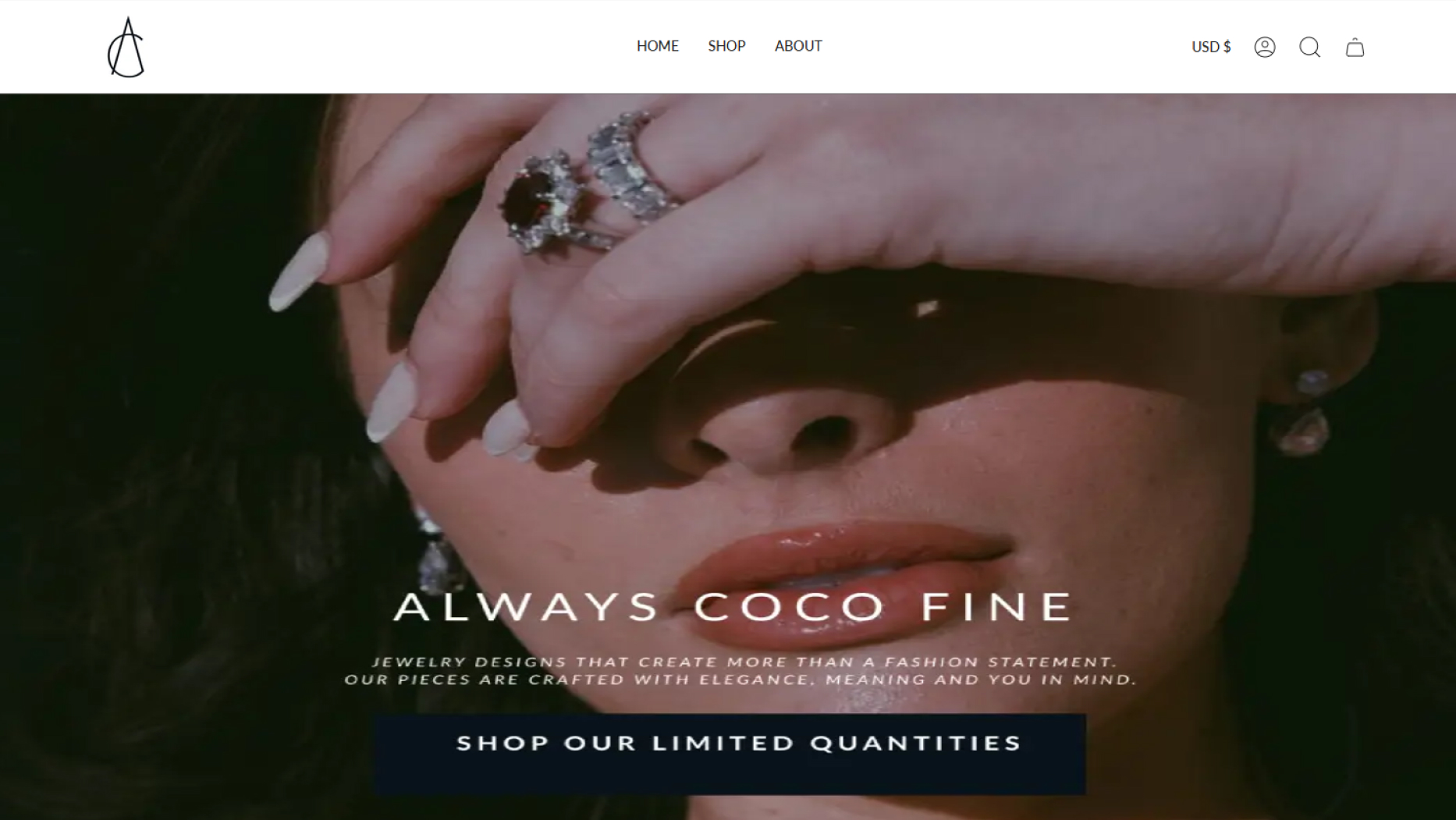
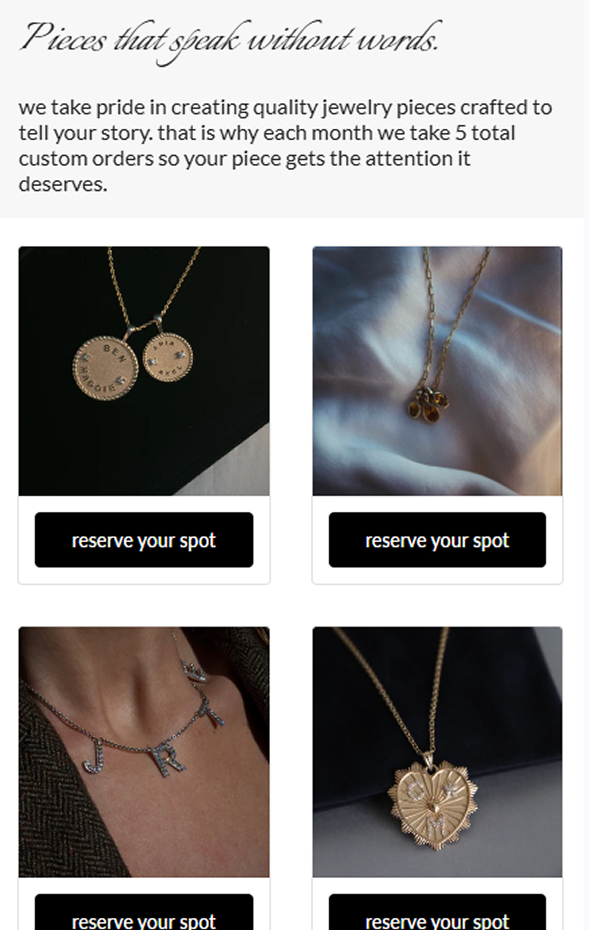
Selected moments from the shipped AlwaysCoco Shopify store where product configuration, multi-currency commerce, and luxury jewelry presentation come together.






Core Features & Functional Capabilities
Built For Luxury Jewelry Commerce
- Customized Shopify Theme: Built on a Shopify theme foundation with structured layout customization, implementing grid-based collections, controlled spacing, and structured banners. This maintains consistent visual hierarchy, readability, responsive behavior, and brand-aligned design across devices.
- Product Pages With Structured Information: Structured product pages with clearly defined attributes, materials, sizes, selectable variants, and segmented sections. It includes care instructions, shipping, returns, and delivery timelines to improve information accessibility, reduce cognitive load, and enable efficient product evaluation.
- Multi-Currency Display Setup: Implemented Shopify Markets-based multi-currency display with region-aware pricing. This enables automatic or user-selected currency switching, ensuring accurate localized pricing visibility for international users without manual conversion or external calculation dependencies.
- Customer Support Information Structure: Integrated structured product-level support information, including variant details and frequently referenced queries. It reduces dependency on external communication channels while enabling users to access essential product and decision-support information independently.
- Payment Processing Setup: Configured Shopify’s native checkout with integrated global payment methods. This ensures secure transaction processing through standardized payment gateways, maintaining reliability, compliance, and consistency throughout the order completion workflow.
Technologies and Tech Stack We Used
Tools Chosen For Scale & Storefront Precision
Shopify Liquid · HTML5 · CSS3 · JavaScript · jQuery · AJAX API
Responsive storefronts with dynamic variants and inquiry flows.
Shopify Online Store 2.0
JSON templates, sections, and scalable theme architecture.
Metafields · Dynamic Sources
Structured product attributes and consistent admin-to-storefront data mapping.
Shopify Checkout · Multi-Currency
Secure payments and region-aware pricing via Shopify Markets.
Testing & Quality Assurance
Validated For Accuracy, Performance & Checkout Stability
Comprehensive QA across variant logic, cart behavior, metafield consistency, responsive layouts, and cross-browser compatibility.
- Validated variant selection logic across all option combinations using controlled test cases and edge-case scenario coverage.
- Verified cart behavior, including add, update, and persistence accuracy.
- Ensured Shopify Online Store 2.0 sections render correctly across pages.
- Checked metafield-driven product data consistency between admin and storefront.
- Tested responsive behavior across major breakpoints and tested cross-browser compatibility across Chrome, Safari, and Edge.
- Confirmed stable Shopify checkout flow with correct pricing and currency handling.
Our Approach & Development Timeline
Phased Delivery Across 12 Weeks
Development followed a phased, architecture-first approach to minimize rework and ensure scalability.
Discovery & Architecture Planning
Product model, metafield schema, and flow mapping.
Online Store 2.0 & Theme Structure
Core Shopify setup and section architecture.
Liquid Template Development
Core templates and conditional product logic.
Frontend Development
HTML, CSS, and JavaScript enhancements.
Metafields & Multi-Currency
Dynamic data and Shopify Markets configuration.
Integrations, Testing & Deployment
QA, optimization, and production release.
Measurable Outcomes
Production-Grade Performance At Global Scale
Delivering quantifiable performance improvements through deep optimization, rendering stability, and robust data integrity. This enables low-latency interactions, frictionless user fl ows, and a high-converting, production-grade storefront experience.
Page load improvement from 3.8s (Lighthouse and real-device testing)
Variant switching down from 600ms (browser performance profiling)
Resolved layout shift issues, achieving negligible CLS (Lighthouse and cross-device testing)
Reduction in UI inconsistencies across major breakpoints and browsers, ensuring a stable cross-device experience
Digisoft Solution engineers Shopify experiences built for performance, scale, and precision. Our work spans full-stack Shopify development from Online Store 2.0 architecture and Liquid engineering to structured metafield systems, multi-currency configuration, and seamless third-party integrations.
Every implementation focuses on clean architecture, maintainable code, and conversion-ready UX. The AlwaysCoco build reflects this approach: a tightly engineered storefront where design, data, and commerce logic operate as a unified system.