PeaceMappers: Global Peace Intelligence Platform
How Digisoft Solution built an AI‑driven peace intelligence system that connects governance, economic, and social data into unified monitoring detecting instability 42% faster and delivering decision‑ready insights for policy and research.







About the Client
PeaceMappers
- IndustryPeace Intelligence & Policy Analytics
- RegionGlobal
- PlatformWeb‑Based Intelligence & Analytics
- Delivery2 Months
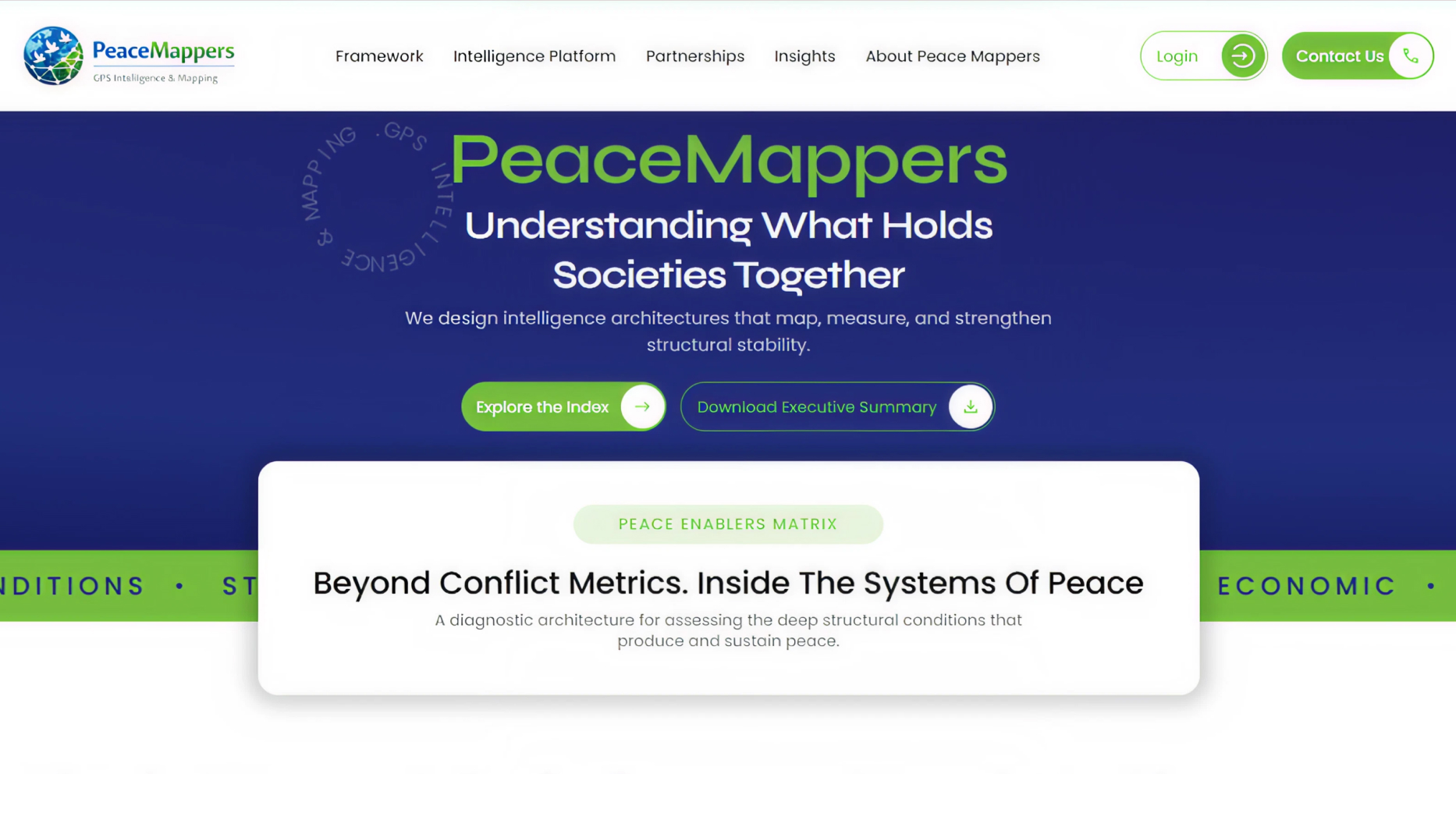
PeaceMappers is a global peace intelligence initiative focused on understanding how societal stability evolves. It is used by government agencies for policy planning, by NGOs for risk monitoring, and by research institutions for systemic analysis. Its objective is to build a structured intelligence framework that supports policy planning, research, and decision-making.
It was developed to interpret complex societal conditions through connected data systems, enabling more informed and context‑aware decision‑making across diverse geopolitical environments integrating multiple layers of information into a unified structure.
Project Overview
Unified Intelligence For Faster, Decision‑Ready Stability Insights
PeaceMappers helps governments and institutions detect societal instability 42% faster using an AI‑driven intelligence system. They transformed fragmented societal data into a unified, continuously monitored intelligence system for policy and research.
It integrates governance, economic, and social data into a single framework, enabling real‑time tracking of interconnected stability indicators. PeaceMappers detects early structural shifts across complex societal systems and converts large‑scale datasets into clear, decision‑ready insights for faster, more informed action.
The client engaged Digisoft Solution to build a scalable system designed to process multi‑layered datasets while ensuring relational integrity across domains. The platform consolidates governance, economic, and social indicators into a unified system, enabling continuous monitoring and early detection of emerging patterns.
The Concept
Stability As A Connected System — Not Isolated Events
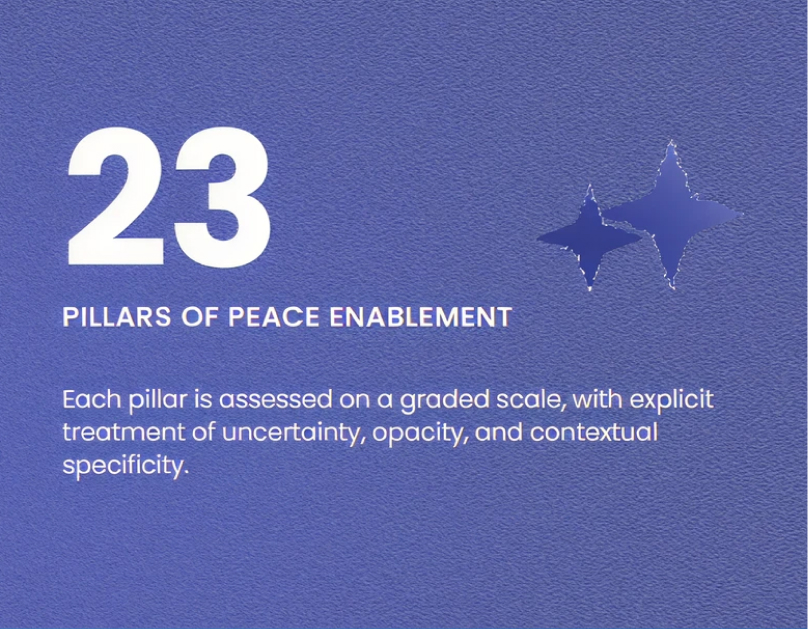
PeaceMappers is built on the principle that stability is best understood as an interconnected system rather than isolated events. The Peace Enablers Matrix (PEM) was developed as a core analytical framework to operationalize this approach. It organizes societal conditions into 23 structured pillars spanning governance, economic systems, social structures, and informal societal mechanisms. Each pillar interacts with others within the system, so the platform can track how changes in one domain influence broader system behavior.
The system focuses on relational dynamics instead of simplified rankings or static scores showing how pressure builds and evolves across interconnected layers over time, enabling earlier and more accurate interpretation of emerging conditions.

Challenges We Addressed
From Fragmentation & Delay To System‑Level Clarity
We identified key gaps in traditional analysis data fragmentation, delayed detection, and misaligned decision‑making before designing PeaceMappers as a connected intelligence layer.
Limitations of Traditional Peace Analysis
Traditional frameworks focus mainly on visible conflict events, offering a limited view of stability. This approach overlooks deeper structural and contextual factors that shape long-term societal dynamics. It leads to a limited understanding of how stability evolves across interconnected domains.
Lack of Early Warning Systems
Most existing analytical models operate in a reactive mode, responding only after instability becomes visible. Subtle shifts in underlying indicators often go undetected, leading to delayed responses and reduced preparedness for emerging risks.
Fragmented Data Analysis
Typically, analysts isolate data on governance, economy, infrastructure, and social parameters. This separation obscures interdependencies between domains and limits the ability to identify cross-system patterns that drive long-term stability or disruption.
Ignoring Informal Systems
Analysts often exclude critical informal structures, such as community influence, cultural norms, religious frameworks, and local mediation mechanisms, from their analysis. Their absence creates an incomplete representation of real-world societal behavior and weakens analytical accuracy.
Over‑Reliance on Rankings
Existing models frequently reduce complex societal conditions into simplified numerical scores. While convenient, this approach removes essential context, masking regional variations and limiting meaningful interpretation of system behavior.
Policy Misalignment
Most decision-making processes do not align with the evolving nature of systems over time. Lack of coordination between insights and interventions leads to inefficient response cycles, reducing the overall effectiveness of policy actions in dynamic environments.
Our Solution to Real‑World Challenges
Structured Diagnostics, Early Signals & Relational Alignment
Digisoft Solution translated PeaceMappers’ vision into modular analytics combining PEM, relational pillars, informal‑system integration, and diagnostic outputs aligned with real‑world policy cycles.
System‑Level Peace Diagnostics
We introduced a structured approach to analyzing system stability rather than isolated events. With this method, we enabled a comprehensive understanding of how conditions interact and evolve across multiple layers over time.
Early Signal Detection Mechanism
We implemented a detection layer to capture gradual changes across indicators. This facilitated early identification of emerging risks, enabling more timely responses and more proactive, informed decision-making.
Relational Analysis Across 23 Pillars
We created a unified model to connect governance, economic, infrastructural, and social systems. This relational structure revealed dependencies, patterns, and interactions that were not visible in previously isolated analysis approaches.
Integration of Informal Systems
Informal structures such as community mediation, belief systems, and local influence were incorporated alongside a formal intelligence framework. These changes ensured a more accurate and complete representation of real-world dynamics.
Diagnostic‑Based Analytical Model
We replaced static rankings with systematic outputs based on system conditions and relationships. This preserved context, improved clarity, and supported deeper interpretation of stability across different regions and environments.
Coordinated Policy Alignment Framework
Our team implemented a well-defined approach to improve the timing and sequencing of decisions. This enabled better coordination across relational architecture, aligning actions with real-world changes and improving the overall effectiveness of interventions.
Main Features & Functionalities
Interactive intelligence for relational mapping & real‑time interpretation
PeaceMappers is an interactive intelligence platform that helps users understand complex societal systems through structured analysis, relational mapping, and real-time data interpretation.
Screens From the Live Build
Surfaces We Designed & Engineered Into Production
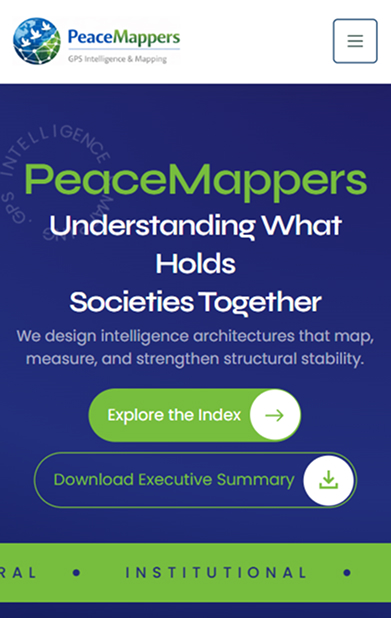
Selected moments from the shipped PeaceMappers platform the surfaces where structured diagnostics, relational mapping and real‑time interpretation come together for researchers, institutions and decision‑makers.




Core Technologies We Used
Modular Layers For Scale, Security & Parallel Delivery
We designed PeaceMappers as a modular system where each layer is responsible for a specific function. It enables independent development, testing, and scaling without impacting overall system stability. The architecture ensured consistent performance while handling multiple data streams and analytical operations simultaneously.
Angular
Interactive dashboards, relational visualizations, and responsive analytical workspaces for global users.
.NET Core · Python (FastAPI)
Core services and analytical APIs — combining enterprise .NET workloads with FastAPI for high‑throughput AI and signal pipelines.
PostgreSQL / SQL Server · Graph · Time‑Series
Relational integrity alongside graph relationships for pillar dependencies and time‑series stores for evolving indicators.
RESTful APIs
Consistent integration across modules, AI interfaces, and external data connectors with predictable contracts.
RBAC · HTTPS · Authentication
Role‑based access control, encrypted transport, and hardened authentication for sensitive peace & policy data.
Testing & Quality Assurance
Quality Gates Across Modules, AI Interfaces & Scale
Rigorous validation ensured PeaceMappers stayed accurate under load, secure across roles, and consistent across integrated analytics and AI‑assisted workflows.
- Functional & workflow testing across all modules and roles
- Role‑based access testing for secure permissions
- Data integrity validation across records and inputs
- Integration & AI interface testing for system connectivity
- Performance & load testing under high usage
- Security testing for access control and communication
- Automation & UAT for workflow validation
- Responsive UI testing across devices
Our Approach & Timeline
From foundation to AI Integration In Eight Focused Weeks
We developed PeaceMappers through a systematic, time-bound approach, ensuring that each stage contributed directly to building a reliable, connected analytical system. The focus remained on aligning system design, data structure, and functionality within a clearly defined timeline.
Data modelling & architecture
Defined schemas, graph‑friendly structures, and service boundaries for multi‑source peace & stability data.
Research & Concept Design
Aligned the Peace Enablers Matrix, relational pillars, and indicator vocabulary with stakeholder workflows.
Development
Built Angular front ends, .NET Core & FastAPI services, analytics modules, and reporting surfaces in parallel.
AI Integration
Wired AI‑assisted interpretation, signal enrichment, and narrative summaries alongside deterministic analytics.
Testing & Validation
Completed functional, security, performance, and cross‑device validation; tuned latency and release readiness.
Outcome or Measurable Results
Measurable Lift In Speed, Clarity & Coordinated Response
PeaceMappers significantly improved how organizations detect and respond to systemic instability:
Increase In Cross-Domain Visibility
Reduction In Fragmented Analysis
Faster Decision Alignment
Improvement In Contextual Accuracy
Stronger Trend-Tracking Capability
Structured Coverage Across All Analytical Pillars
The platform significantly improved how organizations detect, interpret, and respond to systemic instability.
Digisoft Solution delivered the project on time through systematic execution, cross-team coordination, and rigorous quality validation. Our team ensured smooth delivery of complex requirements, achieving a reliable, high-quality solution. The solution exceeded expectations and reinforced Digisoft Solution's reputation for speed, precision, and reliable execution.