Table of Content
- What Is an AI Agent? (And Why the Definition Changes the Price Completely)
- The Three Paths to Building an AI Agent
- Path 1: No-Code and Low-Code Platforms (n8n, Make, Zapier)
- Path 2: Semi-Custom Development Using LLM APIs
- Path 3: Fully Custom AI Agent Development
- All Approaches Side by Side: Which Path Is Right for You?
- Hidden Costs Most AI Agent Budget Guides Skip
- Data Preparation and Cleaning
- Vector Database Infrastructure
- Cloud Infrastructure and Hosting
- Model Retraining and Fine-Tuning
- Human Oversight in Early Months
- Compliance and Legal Review
- Factors That Drive AI Agent Development Cost Up or Down
- How to Reduce Your AI Agent Cost Without Cutting the Wrong Corners
- Start With a Well-Defined Single Use Case
- Use Pre-Trained APIs Before Considering Custom Models
- Route Tasks to the Right Model by Complexity
- Build in Phases and Validate Before Scaling
- Consider Offshore Development with the Right Partner
- Budget for Maintenance From Day One
- How Digisoft Solution Helps You Build AI Agents
- What We Actually Do on AI Agent Projects
- AI Projects We Have Actually Delivered
- Frequently Asked Questions
- What is the difference between a chatbot and an AI agent?
- Can you build an AI agent for free?
- Is n8n better than Zapier for building AI agents?
- How long does it take to build an AI agent?
- What is the most expensive part of building an AI agent?
- What is a RAG agent and how much does it cost to build one?
- Should I use GPT-4, Claude, or an open-source model for my AI agent?
- What is the ongoing monthly cost of running an AI agent?
- Do I need a development team to build an AI agent?
- How do I calculate AI agent development cost for my specific project?
- Which industries benefit most from AI agents?
- What are the hidden costs of AI agent development?
- Can AI agents replace human employees?
- Conclusion
Digital Transform with Us
Please feel free to share your thoughts and we can discuss it over a cup of coffee.
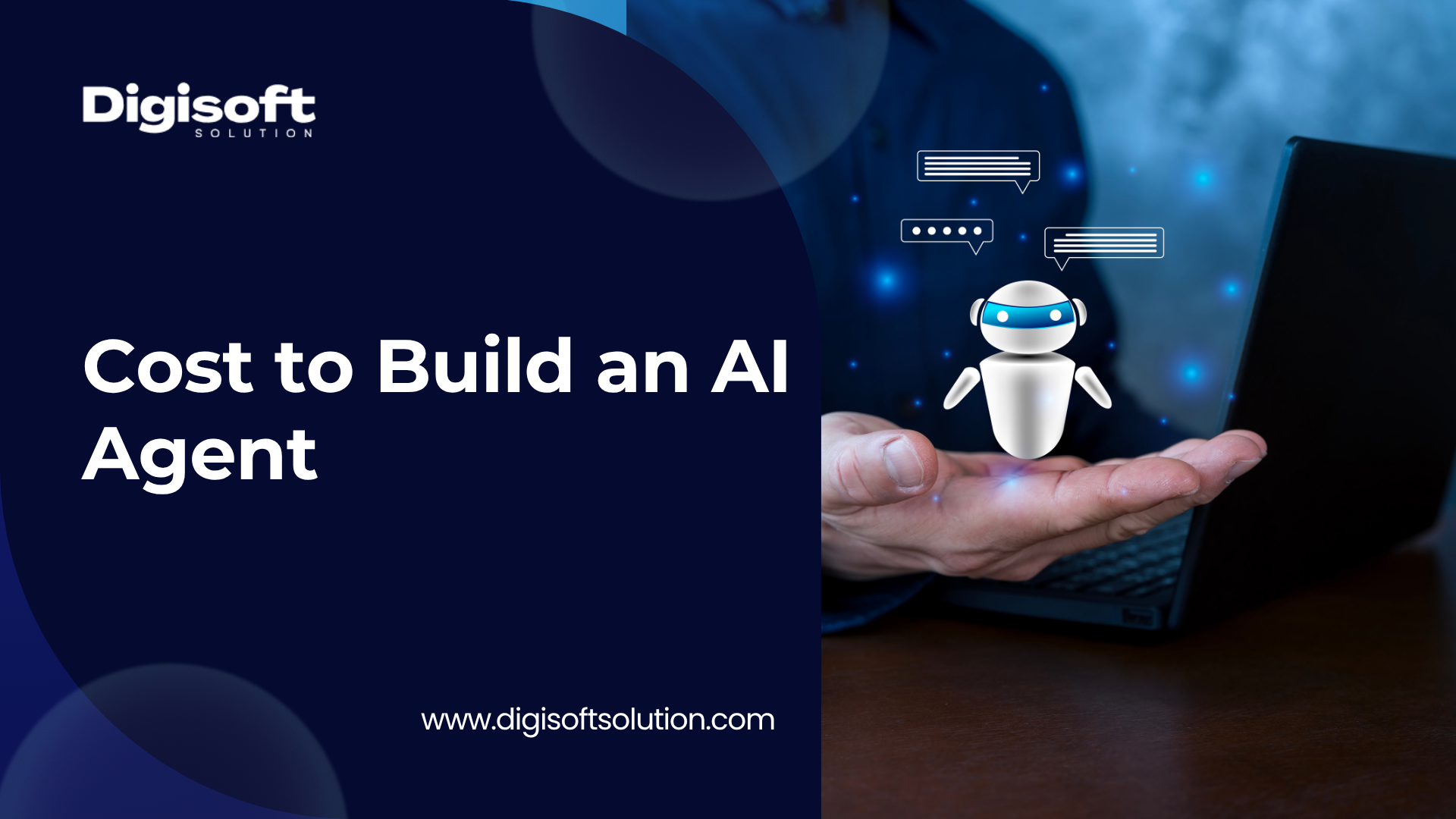
Everyone seems to be building AI agents right now. Customer service bots that actually understand context, internal knowledge assistants that search your documents, and automation pipelines that make decisions without human input. The business case is real. But the moment you sit down to plan the budget, things get confusing very quickly.
You will find articles quoting $5,000 and articles quoting $500,000 for the same thing. Both can be correct. The number depends entirely on what you are building, how you are building it, and who is building it. In this guide, we have broken down the actual cost to build an AI agent across every path available in 2026, from no-code platforms like n8n, Make, and Zapier to fully custom enterprise development. We also cover what drives costs up, what brings them down, what the hidden fees are, and the questions you need to answer before spending a single dollar.
What Is an AI Agent? (And Why the Definition Changes the Price Completely)
This matters more than most people realise. The term "AI agent" gets applied to everything from a simple FAQ chatbot to a fully autonomous system that plans tasks, takes actions, monitors its own outputs, and self-corrects. The cost difference between those two things is roughly $5,000 versus $500,000.
Here is a practical breakdown of the main types you will encounter:
- Rule-Based Chatbots: These follow decision trees and pre-set scripts. They don't actually understand language, they just match patterns. Good for FAQs, simple lead capture, and routing. Cheapest to build.
- LLM-Powered Task Agents: These use large language models like GPT-4 or Claude to understand natural language, reason through problems, and complete multi-step tasks. They actually think, not just pattern-match.
- RAG Agents (Retrieval-Augmented Generation): Connect an LLM to your internal documents, databases, and knowledge bases so the agent answers questions grounded in your specific business data. Extremely useful for internal knowledge management and compliance-heavy industries.
- Multi-Agent Systems: Multiple specialised AI agents working in coordination, each handling a piece of a larger workflow. Think of it as a team of AI workers rather than one generalist.
- Autonomous Agentic Systems: The top tier. These can plan, act, observe results, reflect, and course-correct across long-horizon tasks. Most expensive and most powerful. Enterprise territory.
Each step up adds real cost in terms of development complexity, infrastructure, testing, and ongoing maintenance. If you are new to this, our software development for startups guide covers how to think about scope and phasing before committing to a build approach.
The Three Paths to Building an AI Agent
Before we get into pricing tables, understand that there are three fundamentally different ways to build an AI agent. Which path you choose has more impact on cost than almost any other decision.
Path 1: No-Code and Low-Code Platforms (n8n, Make, Zapier)
This is where most businesses start, and for good reason. Platforms like n8n, Make, and Zapier let you build AI-powered workflows without writing much code, sometimes none at all. They are genuinely capable for many real business use cases. But they have a ceiling, and the pricing mechanics are very different from each other, which is something most articles gloss over.
n8n: The Best Value for Complex AI Agents
n8n is open-source and genuinely the strongest option in this category for businesses that want real AI agent depth at low cost. The core reason comes down to how it bills you. n8n charges per workflow execution, not per task or per step. So a 50-step AI agent workflow costs exactly the same as a 2-step one, if they run the same number of times. For complex agents, this is a massive advantage over Zapier's task-based billing.
In 2026, n8n 2.0 ships with 70 plus native AI nodes, full LangChain integration for building sophisticated agent pipelines, persistent agent memory across executions, vector database support for RAG workflows, and native multi-agent orchestration. You can also self-host it entirely free on your own server, paying only for the server itself, typically $5 to $20 per month on a basic VPS.
|
n8n Plan |
Monthly Cost |
Executions Included |
Best For |
|
Self-Hosted (Community) |
Free (server: ~$5-$20/month) |
Unlimited |
Technical teams comfortable with DevOps |
|
n8n Cloud Starter |
~$24/month |
2,500 executions |
Small teams getting started |
|
n8n Cloud Pro |
~$60/month |
10,000 executions |
Growing businesses with moderate volume |
|
n8n Enterprise |
Custom pricing |
Unlimited + SLA |
Large organisations needing support |
Make (formerly Integromat): Visual Power at Reasonable Cost
Make sits comfortably between Zapier and n8n in terms of technical complexity. Its canvas-based visual builder handles branching logic and parallel processing well, and it is significantly more accessible than n8n for non-developers. Make introduced Make AI Agents (generally available early 2026) and its Maia AI assistant, which builds automation scenarios from plain-English descriptions. For teams that need more control than Zapier but lack developer resources for n8n, Make is a solid middle ground.
The pricing is operation-based. Each step in a scenario counts as an operation. At 100,000 operations per month, Make typically costs under $100, while Zapier can push past $300 for the same volume. Make is roughly 60% cheaper than Zapier at equivalent usage levels.
|
Make Plan |
Monthly Cost |
Operations / Month |
Best For |
|
Free |
$0 |
1,000 |
Testing and prototypes only |
|
Core |
~$10/month |
10,000 |
Solo founders and small projects |
|
Pro |
~$34/month |
40,000 |
Small to mid-size teams |
|
Teams |
~$68/month |
150,000 |
Growing teams with moderate complexity |
|
Enterprise |
Custom |
Unlimited |
Large businesses with high volume |
Zapier: The Easiest Start, But Costs Climb Fast on Complex Agents
Zapier has the largest app ecosystem at 8,000 plus integrations, the most polished user experience, and the lowest barrier to entry. In 2026 Zapier launched Zapier Agents for autonomous task execution and added AI capabilities accessible without coding. For simple AI workflows connecting well-known SaaS tools, Zapier gets you moving the fastest.
The problem is the task-based pricing model. Every single action in a Zap counts as a task. A 10-step Zap firing 1,000 times per month burns through 10,000 tasks. The entry paid plan starts at $19.99 per month for just 750 tasks. For any serious AI agent with multiple steps and real usage volume, Zapier becomes significantly more expensive than n8n or Make. 69% of Fortune 1000 companies use Zapier, but most of those are simple linear automations, not complex AI agents.
|
Zapier Plan |
Monthly Cost |
Tasks / Month |
Best For |
|
Free |
$0 |
100 tasks |
Just testing, very limited |
|
Professional |
~$20/month |
750 tasks |
Very simple, low-volume automations |
|
Team |
~$69/month |
2,000 tasks |
Small teams with simple multi-step flows |
|
Enterprise |
Custom |
Unlimited |
Large organisations with negotiated terms |
Real Talk: Where No-Code Platforms Hit Their Ceiling
These platforms are legitimate and powerful for many real business problems. But there is a ceiling. When you need deep customisation specific to your business logic, proprietary data integration, compliance with regulations like HIPAA or GDPR, or agents that reason in highly domain-specific ways, you will run into the walls of what these platforms can do. The question is not "are these platforms good" but "are they right for what I need."
Realistic total cost for a no-code AI agent: $0 to $5,000 setup (including any agency configuration fees at $50 to $150 per hour, typically 20 to 100 hours depending on complexity), plus $20 to $300 per month in platform fees ongoing.
Path 2: Semi-Custom Development Using LLM APIs
This is the most common path for businesses with real customisation needs but who are not building from scratch. You use APIs from OpenAI, Anthropic, Google, or Meta as the intelligence layer, then build custom application logic, integrations, interfaces, and data pipelines on top. This requires a development team but gives you far more flexibility than no-code platforms.
This is also where choosing the right development partner matters enormously. Whether you hire in-house or work with an offshore team significantly affects cost. Our blog on what an offshore development team actually is and how it works covers the key considerations if you are evaluating that route.
|
AI Agent Type |
Development Cost |
Ongoing Monthly |
Typical Timeline |
|
Simple chatbot / FAQ agent |
$5,000 to $20,000 |
$500 to $2,000/month |
4 to 8 weeks |
|
LLM Task Agent (resume screener, email drafter) |
$20,000 to $50,000 |
$1,000 to $5,000/month |
8 to 16 weeks |
|
RAG Knowledge Agent (internal docs, compliance) |
$50,000 to $100,000 |
$5,000 to $10,000/month |
3 to 6 months |
|
Multi-Agent / Autonomous System |
$100,000 to $250,000+ |
$10,000 to $30,000/month |
6 to 12 months |
What LLM APIs Actually Cost Per Month
Your AI agent needs a brain, and you pay the model provider per token (roughly per word) processed. This feeds directly into your ongoing monthly operating cost. Here is where real-world API pricing currently stands in 2026:
|
Model / Provider |
Input Cost (per 1M tokens) |
Output Cost (per 1M tokens) |
Practical Use Case |
|
GPT-4o (OpenAI) |
~$2.50 |
~$10.00 |
Balanced performance, broad ecosystem |
|
GPT-4o mini (OpenAI) |
~$0.15 |
~$0.60 |
High-volume tasks where cost matters |
|
Claude Sonnet (Anthropic) |
~$3.00 |
~$15.00 |
Long context, complex reasoning tasks |
|
Claude Haiku (Anthropic) |
~$0.25 |
~$1.25 |
Fast, affordable, high-throughput tasks |
|
Gemini 1.5 Pro (Google) |
~$1.25 |
~$5.00 |
Multimodal workflows, Google ecosystem |
|
Llama 3 (Self-hosted) |
Server cost only |
Server cost only |
Data sovereignty, zero per-token fees |
To ground this in reality: a customer service agent handling 10,000 conversations per month, with each averaging 2,000 tokens, consumes roughly 20 million tokens. At GPT-4o rates, that is $200 to $250 per month in model costs alone. Switch to Claude Haiku and the same volume costs under $30. Model selection is one of the highest-leverage decisions in managing ongoing AI agent costs.
Path 3: Fully Custom AI Agent Development
This route is for businesses where unique requirements, sensitive data, regulated industries, or genuine competitive differentiation make off-the-shelf and semi-custom approaches insufficient. You are building the full stack: custom or fine-tuned models, proprietary data pipelines, custom interfaces, integrations with legacy systems, and proper security and compliance infrastructure.
This territory overlaps significantly with enterprise software development. Our blog on enterprise software development costs in 2026 gives broader context on how enterprise-scale systems are scoped and priced.
|
Complexity Level |
Development Cost |
Ongoing Annual Cost |
What Is Included |
|
Basic Custom Agent |
$40,000 to $80,000 |
$10,000 to $25,000/year |
Custom LLM integration, basic UI, 2-3 integrations |
|
Mid-Level Custom Agent |
$80,000 to $200,000 |
$25,000 to $60,000/year |
RAG pipeline, custom data layer, security, 5+ integrations |
|
Enterprise Autonomous Agent |
$200,000 to $500,000+ |
$60,000 to $200,000+/year |
Multi-agent, fine-tuned models, compliance, full MLOps |
Cost Breakdown by Development Phase
Custom AI agent development cost is not a single line item. It stacks up across phases, and understanding this helps you avoid budget surprises:
|
Development Phase |
Typical Cost Range |
What It Covers |
|
Discovery and AI Assessment |
$7,000 to $35,000 |
Requirements, data audit, feasibility, architecture decisions |
|
Backend Development |
$20,000 to $80,000 |
Agent logic, API layer, LLM integration, database design |
|
Frontend / User Interface |
$10,000 to $20,000 |
Chat interface, admin dashboard, user-facing screens |
|
CRM / ERP / API Integrations |
$2,000 to $5,000 per integration |
Data mapping, API development, end-to-end testing |
|
Security and Compliance (HIPAA / GDPR / EU AI Act) |
$5,000 to $30,000+ |
Audit logging, encryption, legal review, certification |
|
Testing and QA |
$5,000 to $15,000 |
Functional, performance, hallucination, and edge-case testing |
|
Deployment and DevOps |
$3,000 to $10,000 |
Cloud setup, CI/CD pipelines, monitoring, alerting |
|
Annual Maintenance |
15 to 25% of build cost/year |
Bug fixes, model updates, retraining, scaling |
All Approaches Side by Side: Which Path Is Right for You?
|
Approach |
Setup Cost |
Monthly Running Cost |
Time to Launch |
Ideal For |
Main Limitation |
|
Zapier |
$0 to $2,000 |
$20 to $300 |
1 to 2 weeks |
Non-technical teams, simple linear automations |
Task pricing escalates fast; limited agent depth |
|
Make |
$0 to $2,000 |
$10 to $150 |
1 to 3 weeks |
Teams needing visual workflow control |
Operation-based pricing; agent features still maturing |
|
n8n (Cloud) |
$500 to $5,000 setup |
$24 to $100+ |
2 to 6 weeks |
Technical teams wanting control at low cost |
Steeper learning curve than Make or Zapier |
|
n8n (Self-Hosted) |
$500 to $3,000 setup |
$5 to $20 (server only) |
3 to 8 weeks |
Full data sovereignty and zero usage fees |
Needs DevOps capacity for setup and maintenance |
|
Semi-Custom (LLM API + Dev) |
$20,000 to $100,000 |
$500 to $10,000 |
2 to 6 months |
Businesses needing real customisation |
Requires reliable development partner |
|
Fully Custom Enterprise |
$100,000 to $500,000+ |
$5,000 to $30,000+ |
6 to 18 months |
Complex, regulated, large-scale deployments |
Major investment; needs experienced AI engineering team |
Hidden Costs Most AI Agent Budget Guides Skip
The development or platform cost is only part of what you will actually spend. These are the items that catch businesses off guard:
Data Preparation and Cleaning
Your AI agent is only as useful as the data it can access and learn from. If your internal documents, historical records, and business data are scattered across emails, PDFs, legacy systems, and spreadsheets, someone has to clean, label, and structure all of it before it is usable. For mid-size businesses with years of accumulated data, this alone can run $5,000 to $30,000.
Vector Database Infrastructure
RAG agents need a vector database to store and search document embeddings efficiently. Options include Pinecone, Weaviate, Qdrant, or pgvector running on PostgreSQL. For a mid-scale production deployment, budget $50 to $500 per month depending on data volume and query frequency.
Cloud Infrastructure and Hosting
Even when you use third-party LLM APIs, you still need to host your application layer, queues, caching layer, monitoring, and databases. A production-ready setup on AWS, GCP, or Azure typically runs $200 to $2,000 per month depending on traffic. This connects closely to cloud application development, which is something the Digisoft team handles end to end so you are not overpaying for infrastructure or under-provisioning it.
Model Retraining and Fine-Tuning
AI models do not stay accurate forever. Data drifts, business logic changes, and new information needs incorporation. Budget for periodic retraining or fine-tuning cycles, which can run $2,000 to $20,000 per round depending on the model and dataset size.
Human Oversight in Early Months
In the first three to six months after launch, someone needs to review agent outputs regularly, catch hallucinations or errors, and feed corrections back into the system. This is a real people cost. Budget 10 to 20 hours per month of technical staff time minimum, especially for agents touching customer-facing or compliance-sensitive workflows.
Compliance and Legal Review
If your agent handles customer data, financial records, or health information, or operates in the EU under the AI Act, you need legal review, compliance audits, and in some cases certification. Depending on the sector and scope, this adds $10,000 to $50,000 to an enterprise AI project. This is especially relevant for healthcare and fintech deployments.
Factors That Drive AI Agent Development Cost Up or Down
- Reasoning complexity: A simple FAQ agent needs basic NLP. An autonomous planner that evaluates multi-step task results and self-corrects needs much more sophisticated architecture, testing, and infrastructure.
- Number and depth of integrations: Each system your agent connects to (CRM, ERP, ticketing, calendar, proprietary database) adds development time and ongoing maintenance. Expect $2,000 to $5,000 per integration for custom work.
- Data quality: Clean, structured, well-labelled data dramatically lowers your cost. Messy, unstructured, siloed data raises it significantly.
- Compliance requirements: Healthcare, finance, and legal have strict frameworks that add real cost. If this is your sector, compliance is not optional and should be designed in from the start.
- Developer location: North American developers charge $100 to $200 per hour. Indian development teams typically run $25 to $60 per hour. Eastern European rates fall between $40 and $90 per hour. With the right partner, you get the same quality at a fraction of the cost.
- Build vs buy the model: Using a pre-trained LLM via API is far cheaper upfront than training or fine-tuning your own model. Fine-tuning only makes sense when you have enough proprietary data and a clear performance gap that the off-the-shelf model cannot close.
- Phasing and scope discipline: The biggest cost driver in any AI project is scope creep and unclear requirements. A proper discovery phase, even if it costs $10,000 to $15,000 upfront, consistently saves $40,000 to $80,000 in rework later.
How to Reduce Your AI Agent Cost Without Cutting the Wrong Corners
Start With a Well-Defined Single Use Case
Do not try to build a general-purpose AI assistant for your whole company in phase one. Pick the single highest-value problem the agent will solve. Narrow scope delivered well beats broad scope delivered poorly every time, especially when you are spending real money.
Use Pre-Trained APIs Before Considering Custom Models
Unless you have a very specific, validated reason to train or fine-tune your own model, use a pre-trained LLM via API. You get 80 to 90% of the capability at a fraction of the cost and timeline. Revisit custom model training only when you have production data showing clear performance gaps.
Route Tasks to the Right Model by Complexity
One of the smartest cost optimisations available is building intelligent model routing into your agent. Simple classification and retrieval tasks go to Claude Haiku or GPT-4o mini. Complex multi-step reasoning goes to GPT-4o or Claude Sonnet. This alone can reduce your ongoing LLM API bill by 40 to 70% without any loss in output quality.
Build in Phases and Validate Before Scaling
A phased approach, an MVP first with defined expansion milestones, reduces initial investment and lets you validate that the agent actually solves the real problem before scaling costs. Most businesses over-engineer phase one.
Consider Offshore Development with the Right Partner
Outsourcing development to a reputable team in India can reduce your build cost by 50 to 70% compared to North American rates without sacrificing engineering quality. The operative word is reputable. Our offshore development team guide explains what to look for and what questions to ask before signing anything.
Budget for Maintenance From Day One
One of the most common budget mistakes is treating the build cost as the total cost. Plan for 15 to 25% of your initial development cost per year in ongoing maintenance, model updates, retraining, and infrastructure scaling. Ignoring this leads to agent degradation and expensive emergency fixes.
How Digisoft Solution Helps You Build AI Agents
Digisoft Solution is an international IT consulting and custom software development company with 13 plus years of experience, 700 plus projects delivered globally, and a team of 100 plus engineers, designers, and AI specialists. We have built production AI systems for clients in healthcare, fintech, logistics, real estate, retail, and urban intelligence. Not demos. Actual working systems solving real business problems.
Unlike vendors who send a proposal before understanding your problem, our process always starts with understanding your business first, then defining the right architecture, model selection, and build approach. Only then does development begin.
What We Actually Do on AI Agent Projects
- End-to-end AI agent development: LLM selection, RAG pipeline architecture, custom integrations, user interfaces, cloud deployment, and post-launch monitoring. We handle the full stack. See our software development services for an overview of our engineering capabilities.
- Cloud-native AI infrastructure: We design and build AI agent infrastructure on AWS, GCP, and Azure that scales with your actual usage and does not leave you paying for capacity you do not need. More at our cloud application development page.
- Industry-specific expertise: We have delivered HIPAA-compliant healthcare software, fintech platforms, logistics systems, and retail solutions. Compliance and security are built into our process from the start, not reviewed at the end
- Dedicated development teams: If you need a team embedded in your workflow rather than a project-based engagement, our dedicated developer model gives you direct access to your engineering team with full transparency on work and costs.
- Mobile and web application integration: If your AI agent needs a polished user-facing interface, our mobile app development and web application development teams build the front-end layer alongside the AI backend.
AI Projects We Have Actually Delivered
Veridian Urban Systems: An AI-driven urban intelligence platform with real-time dashboards, KPI tracking, and 42% faster city insight generation. Read the case study.
PeaceMappers: An AI peace intelligence platform connecting governance, economic, and social data to detect instability 42% faster than previous methods. Read the case study.
S Cubed ABA Therapy Platform: A HIPAA-compliant ABA therapy practice management system enabling real-time care tracking and multi-clinic management. Read the case study.
See all case studies at digisoftsolution.com/case-studies.
The right first step is not a proposal, it is a conversation. Our free consultation includes a technical roadmap and cost estimate for your specific AI agent project. You will speak with senior engineers who build these systems, not salespeople. Book a free consultation at digisoftsolution.com/contact-us.
Frequently Asked Questions
What is the difference between a chatbot and an AI agent?
A chatbot follows pre-written scripts or decision trees and matches user input to pre-defined responses. It does not understand language, it pattern-matches. An AI agent, by contrast, uses large language models to actually reason through problems, take multi-step actions, connect to external tools and data sources, and adapt to situations it was not explicitly programmed for. A chatbot answers "what are your business hours." An AI agent can look up a customer's order history, understand the context of their complaint, draft a resolution email, and log the interaction in your CRM automatically.
Can you build an AI agent for free?
Yes, within limits. n8n offers a completely free self-hosted version where you only pay for server costs, typically $5 to $20 per month on a basic VPS. Make offers 1,000 free operations per month. Zapier has a free tier with 100 tasks. Many LLM providers offer free tiers with limited usage for testing. For a genuine production AI agent handling real business volume, you will need paid plans and likely some investment in proper configuration. "Free" is a great place to experiment and validate your use case, not a realistic target for a production deployment.
Is n8n better than Zapier for building AI agents?
For complex AI agents, n8n is significantly better value. The fundamental difference is how they charge. n8n charges per workflow execution regardless of how many steps are in that workflow, so a 50-step AI agent and a 2-step automation cost the same per run. Zapier charges per task, meaning every step in your workflow multiplies your bill. A 10-step agent firing 1,000 times per month burns 10,000 Zapier tasks. Beyond cost, n8n 2.0 has 70 plus native AI nodes, full LangChain integration, persistent memory, vector database support, and full self-hosting for data sovereignty. Zapier is genuinely better for simple, quick automations where technical simplicity matters more than agent depth or cost.
How long does it take to build an AI agent?
It depends entirely on the approach and complexity. Using n8n or Make with good configuration, a functional AI agent can be live in 1 to 4 weeks. Semi-custom development using LLM APIs typically takes 2 to 6 months for a production-ready deployment. Fully custom enterprise-grade AI systems with compliance requirements take 6 to 18 months. The single biggest timeline variable is not the technology, it is how clearly the requirements are defined before development starts. Vague requirements consistently double timelines.
What is the most expensive part of building an AI agent?
For custom development, backend engineering and LLM integration tend to be the largest line items. Data preparation costs are often underestimated and can rival backend development in time and cost for businesses with messy or siloed historical data. For ongoing operations, LLM API usage and cloud infrastructure are the main monthly drivers. Compliance and security work is the biggest surprise cost for regulated industries, often adding $15,000 to $50,000 that was not in the initial estimate.
What is a RAG agent and how much does it cost to build one?
A RAG agent (Retrieval-Augmented Generation) connects an LLM to your internal documents, knowledge bases, databases, or proprietary data so the agent answers questions grounded in your specific business context rather than just its training data. This is critical for any use case where accuracy on your particular information matters, like internal HR policy lookups, legal document analysis, or clinical protocol retrieval. Building a RAG agent typically costs $50,000 to $100,000 for custom development, with ongoing monthly costs of $5,000 to $10,000 covering data pipelines, vector database infrastructure, and monitoring. Our team at Digisoft Solution has built RAG systems for healthcare and urban intelligence clients where the accuracy of grounded answers was non-negotiable.
Should I use GPT-4, Claude, or an open-source model for my AI agent?
It depends on your use case, data sensitivity, and budget. GPT-4o and Claude Sonnet are the strongest options for complex reasoning, long-context understanding, and nuanced task handling, but they cost more per token. For high-volume, simpler tasks like classification, summarisation, or routing, GPT-4o mini or Claude Haiku deliver strong performance at a tenth of the cost. Open-source models like Llama 3, self-hosted on your own infrastructure, eliminate per-token fees entirely but require server management expertise and ongoing maintenance. Most production AI agents use a routing strategy that assigns simple tasks to cheaper models and complex reasoning to more capable ones. This alone can reduce monthly API costs by 40 to 70%.
What is the ongoing monthly cost of running an AI agent?
It varies significantly by approach. A no-code agent on n8n Cloud or Make typically costs $24 to $150 per month in platform fees plus LLM API costs. A semi-custom LLM-based agent for a mid-size business typically runs $1,000 to $5,000 per month including infrastructure and API costs. Enterprise autonomous multi-agent systems with high traffic and compliance monitoring can run $10,000 to $30,000 per month at scale. The ongoing cost always has three components: platform or infrastructure fees, LLM API usage, and human oversight time for reviewing outputs and handling edge cases.
Do I need a development team to build an AI agent?
Not necessarily, it depends on what you are building. With Make or Zapier and some technical comfort, many business owners build functional agents themselves. n8n requires a bit more technical confidence but is manageable for someone willing to invest time learning it. For anything that needs custom integrations, proprietary data pipelines, a branded user interface, or regulatory compliance, yes, you need a development team. The decision is whether you hire in-house, use an offshore team, or partner with an agency that specialises in AI systems.
How do I calculate AI agent development cost for my specific project?
The most accurate way is a proper scoping conversation with a technical team that understands AI systems. Generic cost calculators and price guides are useful for ballpark estimates but cannot account for your specific data situation, integration complexity, compliance requirements, or team constraints. We offer a free technical consultation with cost estimation at digisoftsolution.com/contact-us. You will get a real number for your specific project, not a range lifted from an article.
Which industries benefit most from AI agents?
Customer service and support automation see some of the fastest ROI. Beyond that, healthcare (clinical data retrieval, scheduling, HIPAA-compliant document processing), fintech (fraud detection, compliance monitoring, customer onboarding), logistics (route optimisation, shipment tracking, exception handling), real estate (lead qualification, document analysis, market intelligence), and retail and e-commerce (personalisation, inventory management, returns automation) all see strong results. The common thread is any workflow that is repetitive, data-heavy, and currently handled by humans doing cognitive work that follows patterns.
What are the hidden costs of AI agent development?
The development or platform cost is only part of the total. Data preparation and cleaning often runs $5,000 to $30,000 for businesses with years of accumulated, unstructured data. Vector database infrastructure for RAG agents adds $50 to $500 per month. Cloud hosting for the application layer runs $200 to $2,000 per month depending on scale. Model retraining cycles cost $2,000 to $20,000 per round. Compliance and legal review in regulated industries adds $10,000 to $50,000. And human oversight time in the first 6 months is a real people cost that rarely appears in vendor proposals. Budget for all of these from the start.
Can AI agents replace human employees?
Partially and selectively, yes. For high-volume, repetitive cognitive tasks that follow clear patterns, AI agents can handle the workload of multiple human employees. But they are not a general-purpose replacement. They struggle with genuine ambiguity, novel situations, relationship management, and anything requiring real-world judgment outside their training scope. The most successful deployments treat AI agents as assistants that handle the routine work so human employees can focus on the judgment-heavy, relationship-driven, and genuinely creative work.
Conclusion
The cost to build an AI agent in 2025-26 is genuinely wide, ranging from near-zero for a basic n8n self-hosted workflow to several hundred thousand dollars for a fully custom enterprise-grade autonomous system. The number that matters is not the industry average but the number for your specific use case, your data, your compliance requirements, and your team.
What we would tell any business at this decision point: do not start with a budget. Start with a clear definition of the problem you are solving, what success looks like, and what data you have. The right path and the right cost follow from that clarity.
If you want help working through that, the team at Digisoft Solution has been delivering custom software and intelligent systems for over 13 years across healthcare, fintech, logistics, retail, and beyond. We offer a free consultation with a technical roadmap and cost estimate at digisoftsolution.com/contact-us. Come with your problem. We will help you figure out the solution.
Digital Transform with Us
Please feel free to share your thoughts and we can discuss it over a cup of coffee.