Secure Titan: Modern Email Protection with Intelligent Encryption & Policy Control







About The Client
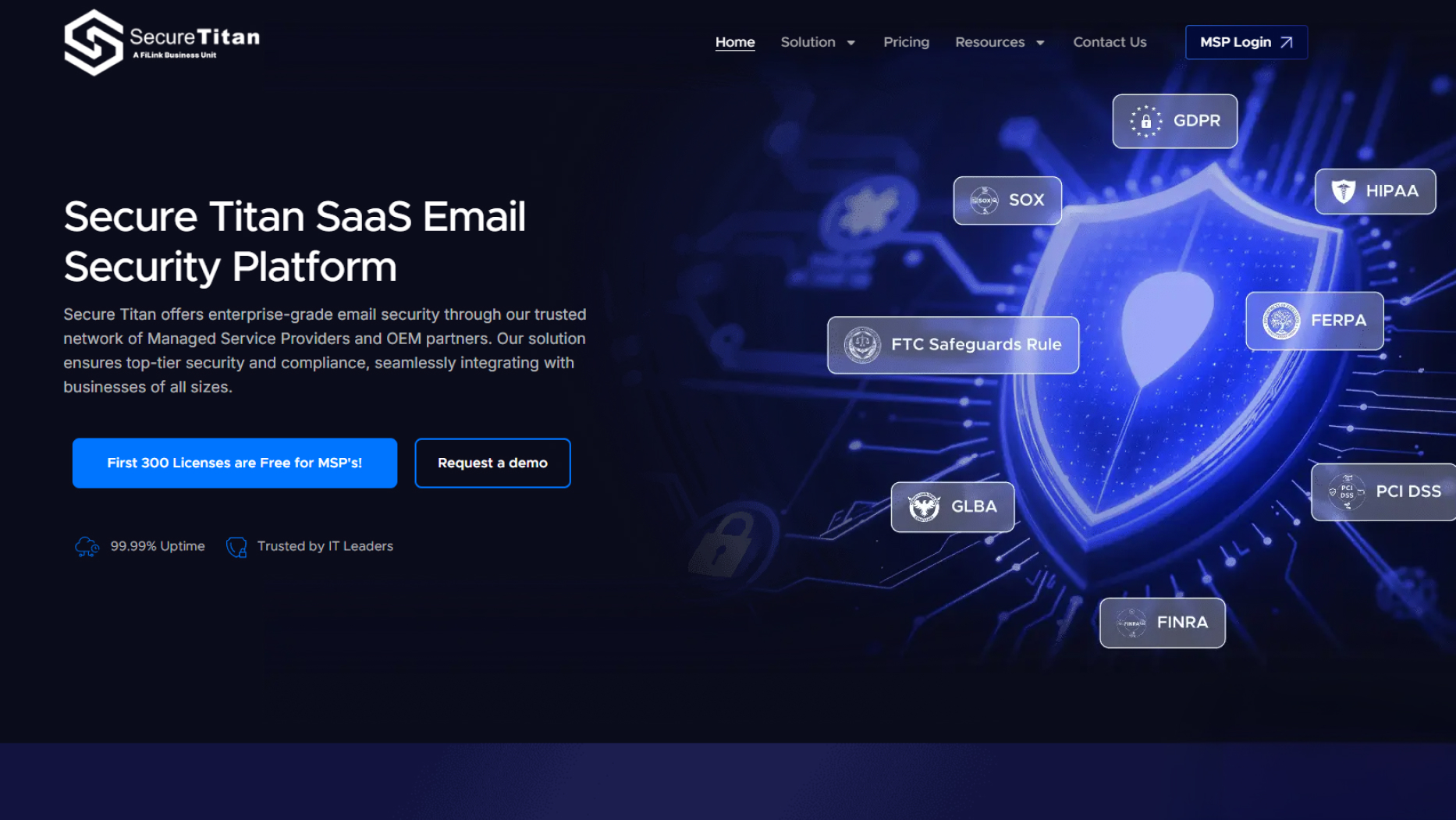
SecureTitan
- IndustryEmail Security / Cybersecurity
- RegionUSA
- PlatformCloud SaaS Email & Security Platform
- Delivery5 years
Secure Titan operates in the email security and managed services domain, supporting organizations using Microsoft 365 and Google Workspace. The client required a unified SaaS platform to standardize email protection, simplify tenant management, and ensure consistent policy enforcement across distributed email environments.
Project Overview
Centralized Policy Control Across Multi-Tenant Email Environments
Managing email security across multiple tenants was challenging due to inconsistent rules, fragmented controls, and limited visibility into email processing. The client required a centralized platform to standardize policy enforcement and improve control over email security operations.
Digisoft Solutions developed a cloud-based email security platform that unifies policy management across tenants, improves operational visibility, and ensures consistent governance of email flow. The solution enhances secure email handling through unified administration and policy-based controls.
The Concept
Policy-Driven Decisions Before Every Secure Delivery
Secure Titan is a cloud-based SaaS email security platform built on a centralized policy-driven decision engine. The system evaluates the recipient domain, policy rules, encryption requirements, and organizational policies before determining delivery handling.
The platform operates on a multi-tenant architecture. It allows multiple organizations to maintain isolated configurations within a shared infrastructure while ensuring strict data and policy separation.
The system routes emails based on policy evaluation through the appropriate secure delivery path. This ensures compliance with organizational security requirements and controlled email flow across environments.
Security decision-making is decoupled from email transport so Microsoft 365, Google Workspace, and SMTP systems stay in place while protection stays consistent.
Key Challenges Addressed
Fragmented Controls Met With Unified Email Governance
Inconsistent Email Security Across Multiple Platforms
Organizations used Microsoft 365, Google Workspace, and SMTP-based systems, each with different encryption and delivery behaviors. The platform needed to standardize secure email handling across all environments while maintaining compatibility with existing communication systems.
Lack of Centralized Policy Enforcement Across Tenants
Security policies were fragmented across multiple organizational environments, leading to inconsistent enforcement and weak governance. A unified policy framework was required to ensure consistent rule application across all tenants.
No Control Over Email After Delivery
Once an email was delivered, organizations had no ability to restrict access, revoke visibility, or enforce post-delivery security actions. A mechanism was needed to maintain control over sensitive communications even after delivery.
Gaps in Compliance Visibility and Auditability
There was no consolidated mechanism to track email activity, generate audit trails, or support regulatory reporting across environments. This created challenges in meeting compliance and forensic investigation requirements.
Complex Secure Access Experience for Recipients
Existing secure email systems introduce friction when accessing protected messages, often requiring complex authentication steps or external tools, which impact usability and adoption.
Technical Solutions We Implemented
Ten Solutions For Delivery, Compliance & Tenant Isolation
Dynamic routing, real-time audit trails, recall controls, Outlook integration, and cross-platform compatibility without replacing existing mail infrastructure.
Dynamic Secure Email Delivery Engine
A recipient’s email environment is against the recipient's system, security policies, and organizational rules. Based on this evaluation, the system determines the appropriate secure delivery method to ensure consistent and compatible email protection across platforms.
Real-Time Email Activity Tracking & Audit System
A centralized logging system captures all email events in real time, including delivery status, access events, and user interactions. These records are structured into audit-ready logs to support compliance reporting and investigations.
Email Recall & Access Revocation Mechanism
The system supports portal-based secure messages with token-based access revocation via session invalidation. For SMTP-delivered emails. Its access is controlled by recipient email providers and cannot be revoked after delivery.
Outlook Add-in-Based Integration
The Outlook Web add-in is integrated with the Microsoft Graph API and Exchange Online. This enables policy enforcement and encryption within Microsoft 365 Outlook without external tools.
Multi-Tenant Isolated Architecture
The system supports multiple organizations within a shared infrastructure while maintaining logical isolation through scoped configuration, access control, and data partitioning. Each organization operates with independent policies, configurations, and administrative controls.
Compliance-Based Control Framework
A structured policy enforcement system governs encryption, access control, and message handling. All actions are logged to ensure traceability and compliance with regulatory standards.
Secure Attachment Processing Layer
Attachments are validated using MIME checks, scanned for malware via antivirus engines, and delivered through controlled access mechanisms with restricted download permissions.
High Availability Cloud Infrastructure
The platform is deployed on a fault-tolerant architecture designed for continuous operation. This ensures reliable email processing, rule execution, and system availability.
Cross-Platform Email Compatibility Layer
Integration modules ensure consistent security enforcement across Microsoft 365, Google Workspace, and SMTP-based systems. This maintains uniform behavior regardless of email provider.
Simplified Secure Access Flow
A token-based authentication allows recipients to access protected emails through secure, time-bound access without introducing workflow complexity or additional software dependencies.
Architecture Approach: Why It Works Better
Centralized Policy Evaluation With Transport Decoupling
The platform is built on a centralized policy evaluation architecture that decouples security decision-making from email transport execution. Each email is processed through a real-time decision engine. The engine evaluates the recipient environment, organizational policies, and encryption requirements before determining the delivery path.
This decision layer dynamically routes emails through appropriate secure channels without modifying underlying email infrastructure such as Microsoft 365, Google Workspace, or SMTP systems.
A multi-tenant isolation model is implemented at the architectural level to ensure strict separation of organizational data and configurations while operating on a shared, scalable infrastructure foundation.
Screens From the Live Build
Surfaces We Designed & Engineered Into Production
Selected moments from the Secure Titan platform policy enforcement, tenant administration, secure delivery, and audit visibility across multi-provider email environments.
Core Features & Functionalities
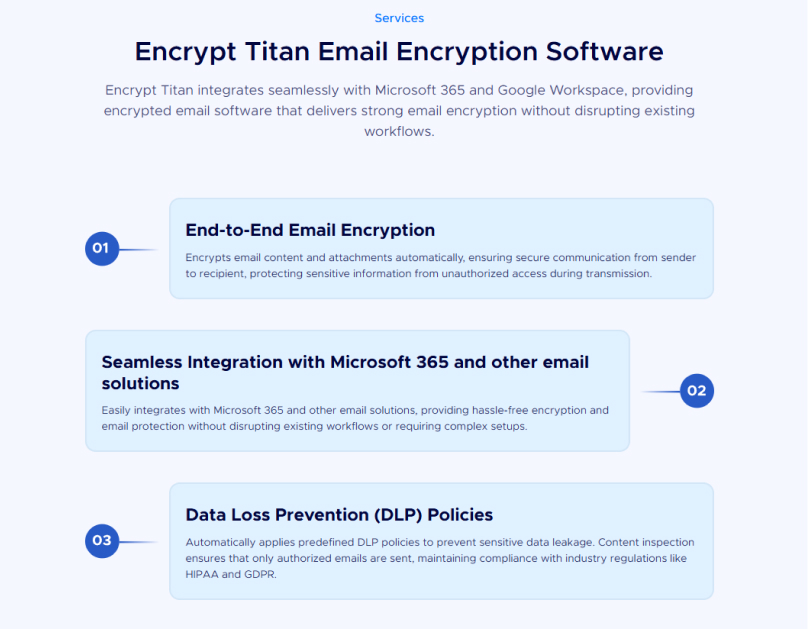
Built For Policy Control & Secure Delivery
- Rule-Based Email Processing Engine: Emails are evaluated against centrally defined security rules before delivery. The system automatically determines processing behavior based on recipient conditions, ensuring consistent enforcement of organizational policies.
- Secure Email Delivery & Encryption Control: Messages are transmitted using opportunistic or enforced TLS when supported. When secure transport requirements cannot be validated, the platform routes messages through a secure access portal.
- Cross-Platform Email Compatibility: The platform supports Microsoft 365, Google Workspace, and SMTP-based systems. Security rules are normalized across providers to ensure consistent processing regardless of email infrastructure.
- Real-Time Tracking & Audit Logging: All email events are recorded throughout the lifecycle, including delivery status and user interactions. This provides a centralized activity trail for monitoring and review purposes.
- Post-Delivery Access Control (Recall & Revocation): For portal-based emails, access can be revoked via session/token invalidation; inbox-delivered emails are governed by the recipient's email platform retention and cannot be fully recalled.
- Multi-Tenant Administration & Policy Management: The system supports multiple organizations within a shared infrastructure. Each tenant maintains its own configuration, user access, and policy controls.
Technologies and Tech Stack We Used
Tools Chosen For Scale, Security & Dual-Database Operations
C# · .NET 6
Core email processing, policy enforcement, delivery engine, and API services.
Angular 7 · Angular Material · JavaScript · HTML5 · CSS3 · Bootstrap
Tenant dashboards & admin interfaces. Role-based access, policy & secure email workflows.
SQL Server 2019 · MySQL
Dual-database architecture—SQL Server for core transactions and MySQL for supporting services and metadata.
Visual Studio 2019
Integrated development environment for backend and full-stack delivery.
Dual-database architecture using SQL Server for core transactions and MySQL for supporting services and metadata management.
Testing & Quality Assurance
Validated For Delivery, Compliance & Tenant Separation
End-to-end QA across Microsoft 365, Google Workspace, SMTP, encryption workflows, audit logs, and high-traffic concurrent usage.
- Evaluated secure email delivery workflows across Microsoft 365, Google Workspace, SMTP, and API-based integrations.
- Tested automatic encryption rules, user access controls, and role-based permissions for administrators, partners, and end users.
- Validated audit logs, message tracking, retention policies, and deletion of expired email records.
- Encryption, retention, and access-control workflows are designed to align with HIPAA, GDPR, FERPA, GLBA, and PCI DSS requirements.
- Tested tenant-level data separation, authentication processes, Outlook add-in functionality, and white-label customer environments.
- Verified platform stability, browser compatibility, responsive behavior, and performance under high email traffic and concurrent usage.
Our Approach & Development Timeline
Phased Delivery Across 5 Years
From requirements and architecture through backend, frontend RBAC, integration testing, deployment, and ongoing maintenance.
Requirements Gathering & Project Planning
Scope, tenant model, and multi-provider integration requirements.
System Architecture Design & System Blueprinting
Policy engine, delivery paths, and multi-tenant isolation design.
Backend Development & Core Functionality Implementation
Delivery engine, audit system, attachment processing, and APIs.
Frontend Development & RBAC Implementation
Tenant administration, policy management, and role-based dashboards.
System Integration, Testing & Quality Assurance
Cross-platform validation, compliance workflows, and load testing.
Deployment, Performance Optimization & Ongoing Maintenance
High-availability rollout, performance tuning, and continuous platform support.
Measurable Outcomes
Faster Processing With Higher Delivery & Compliance Confidence
The platform improved secure email operations, compliance management, and delivery reliability. This reduced manual effort and operational delays across organizations.
Reduced secure email processing time from 4 minutes to under 1 minute through automated encryption workflows
Improved secure email delivery success rate from 82% using TLS detection, MX validation, and policy-based fallback
Reduced accidental exposure incidents related to unsecured email handling
Compliance audit preparation down from 3 weeks through centralized audit logs and automated reporting
Digisoft Solutions developed a centralized cloud-based email security platform for SecureTitan. It unifies policy enforcement and improves secure email delivery. It also simplifies compliance management across Microsoft 365 and multi-provider environments.
The platform works alongside existing email systems. It supports centralized policy enforcement, secure delivery workflows, audit tracking, and tenant-level isolation without disrupting communication processes.