Table of Content
- Quick answer
- What Property Management Software Actually Needs to Cover
- In-House Development: What You Actually Get
- Advantages
- Trade-offs
- Outsourcing PropTech Development: What You Actually Get
- Advantages
- Trade-offs
- A Practical Way to Decide
- A Note on Cost
- Migration and Implementation Considerations
- How Digisoft Solution Help in Modernizes Property Management Development
- Frequently Asked Questions
- Is outsourcing cheaper than hiring in-house developers?
- Can we outsource the build and bring maintenance in-house later?
- What is CAM reconciliation and why does it matter for commercial real estate software?
- How long does a typical property management platform migration take?
Digital Transform with Us
Please feel free to share your thoughts and we can discuss it over a cup of coffee.
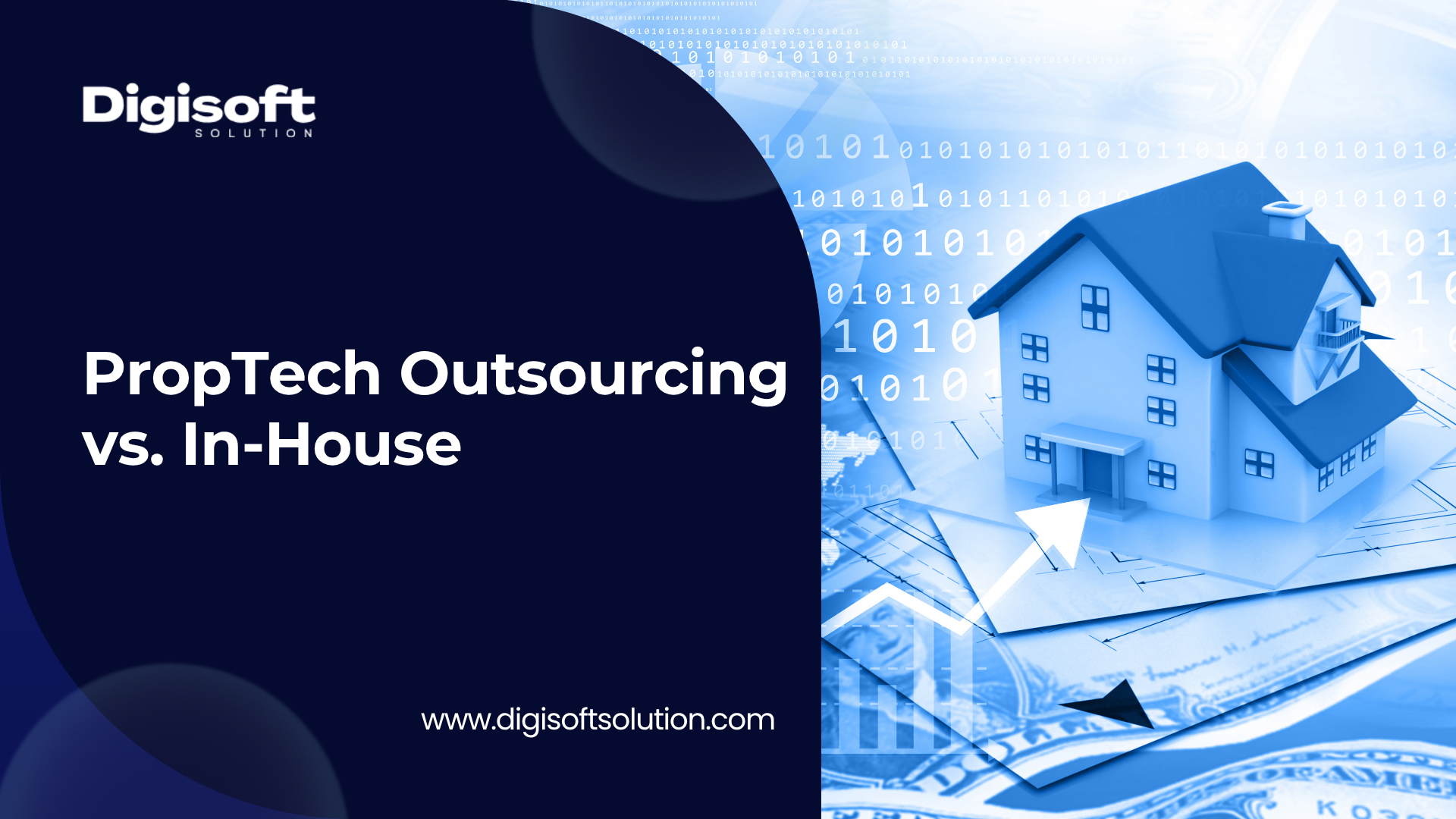
At some point, most property management and commercial real estate companies outgrow the mix of spreadsheets, generic accounting software, and a couple of disconnected tools they started with. The decision that follows is rarely about whether to build software. It is about who should build it. Do you hire an in-house development team, or do you bring in an outsourced partner to build and maintain the platform. Both paths work. Both also fail in fairly predictable ways when the decision is made for the wrong reasons.
Quick answer
PropTech outsourcing means hiring an external development team to build and maintain your property management or commercial real estate software, while in-house means hiring your own full-time developers to do it. Outsourcing is generally faster to start and cheaper in the short to medium term, while in-house gives more day to day control and works best once a platform is stable and no longer changing shape every quarter. Many companies outsource the initial build, then bring maintenance in-house once things settle.
This guide breaks down what proptech software actually needs to cover, how in-house and outsourced development compare on cost and control, and how to think through a migration if you are moving off legacy tools.
What Property Management Software Actually Needs to Cover
Proptech is a broad label, but most property management and commercial real estate platforms need to handle a similar core set of functions:
- Lease management, renewals, and rent escalation tracking
- Tenant portals for payments, maintenance requests, and communication
- Maintenance and work order dispatch, often with vendor scheduling
- Accounting and financial reporting, including CAM reconciliation for commercial properties
- Integrations with MLS data, accounting platforms, and sometimes IoT devices for smart building features
- Owner and investor reporting dashboards for portfolios with multiple stakeholders
Residential property management platforms tend to weigh more heavily toward tenant portals and maintenance workflows, while commercial real estate software leans harder into lease abstraction, CAM reconciliation, and investor reporting. Knowing which side of that line your business sits on changes the scope significantly before a single line of code gets written, and it is worth spelling out on paper before you talk to anyone about a build, in-house or outsourced.
In-House Development: What You Actually Get
Building an in-house team means hiring developers, a product owner, and likely QA staff, all dedicated to your platform full time.
Advantages
- Full control over priorities day to day, with no competing client work slowing things down
- Deep institutional knowledge builds up over time as the same people work on the platform for years
- Easier to react instantly to urgent bugs or changes since the team is already embedded in the business
Trade-offs
- Hiring, onboarding, and retaining developers takes months, and turnover means knowledge walks out the door
- You are paying full salaries, benefits, and overhead even during slower development periods
- Smaller in-house teams often lack specialized experience in niche areas like MLS integrations or CAM reconciliation logic, since that is not something a generalist developer touches often
Outsourcing PropTech Development: What You Actually Get
Advantages
- Access to a team that has likely solved similar integration and workflow problems before, on other real estate projects
- Costs scale with the work. You are not carrying a full team's salary during quieter periods
- Faster ramp up, since the team, tooling, and QA process already exist rather than needing to be built from scratch
Trade-offs
- Requires clear documentation and communication, since the team is not sitting in your office absorbing context passively
- Ongoing support needs to be planned for explicitly in the contract, rather than assumed
- Quality varies significantly between outsourcing partners, which makes vetting a real step, not a formality
A Practical Way to Decide
Rather than treating this as an all or nothing choice, it helps to look at it through a few lenses:
- How specialized is the platform. Highly custom CRE reporting or CAM logic often benefits from a partner who has built it before, in-house or outsourced
- How fast do you need to move. Outsourced teams typically ramp up faster since the hiring step is removed
- What does long-term ownership look like. Some companies outsource the initial build, then bring a smaller in-house team on to handle day to day maintenance once the platform is stable, which is a common middle path
- What is your realistic in-house hiring capacity. A property management company competing with software companies for the same developer talent pool is often at a disadvantage on salary and career growth, which affects retention
That middle path is worth spelling out a bit more, since it is the option most people do not think to ask about upfront. A team can bring in a partner for staff augmentation to sit inside an existing development process for a specific integration, such as an MLS feed or a CAM reconciliation module, without handing over the whole platform. That is a very different arrangement from a full outsourced rebuild, and it is worth being explicit about which one you are actually asking a vendor to quote.
A Note on Cost
Cost comparisons between in-house and outsourced proptech development get skewed easily if you only compare hourly rates, since that ignores the overhead of full-time hiring, benefits, and idle time between projects. A more useful comparison estimates total hours needed for the build, whichever path you choose, then adds the in-house side's recruiting time, benefits, and management overhead on top of salary.
For a mid-sized property management platform covering lease management, a tenant portal, and basic accounting integration, that build typically lands somewhere in the 800 to 1,400 development hour range before ongoing maintenance is factored in. Getting a real number for your situation means scoping the actual feature list first, since generic per-hour comparisons from other agencies' marketing pages rarely reflect what your specific platform needs.
Migration and Implementation Considerations
If you are moving off a legacy property management system rather than building from zero, a few things tend to matter more than the new feature list:
- Data migration from the old system, particularly historical lease and financial data, which needs careful mapping rather than a straight export and import
- Tenant and owner communication during the transition, since portal logins and payment methods usually need to be re-established
- Running the old and new systems in parallel for at least one billing cycle to catch discrepancies before fully cutting over
- Staff training, which is often underestimated and becomes the actual bottleneck to go-live rather than the technical migration itself
How Digisoft Solution Help in Modernizes Property Management Development
Digisoft Solution builds and modernizes property management and commercial real estate software as part of its broader real estate software development work, including tenant portals, lease management systems, and integrations with accounting and MLS platforms. For a company weighing outsourcing against an in-house build, here is what working with Digisoft actually involves:
- Systems mapping before scoping: current workflows, existing tools, and data sources are documented before any proposal goes out, so a migration or new build does not surface expensive surprises midway through
- Experience with the specialized logic that trips up generalist teams: CAM reconciliation, lease abstraction, and MLS or IoT integrations are handled by developers who have built this specific logic before, not learning it for the first time on your project
- A choice of engagement models rather than one fixed arrangement: a company can bring Digisoft on as a full outsourced build partner, or use staff augmentation to add one or two specialists to an existing in-house team for a specific integration, without handing over the whole platform
- Migration support built into the process: parallel-run periods, data mapping, and tenant or owner communication planning are treated as part of the project timeline rather than an afterthought once the new system is ready
- A path to bring maintenance in-house later: for companies that eventually want their own small team managing the platform day to day, Digisoft Solution structures documentation and knowledge transfer from the start so that handoff is realistic rather than theoretical
For companies weighing outsourcing against hiring in-house, a proptech software outsourcing conversation with a team that has already built these systems is usually a faster way to get a real cost and timeline picture than running the numbers in isolation.
Frequently Asked Questions
Is outsourcing cheaper than hiring in-house developers?
Usually cheaper in the short to medium term, since you are not carrying full-time salaries and benefits during slower periods. Over a multi-year horizon with a stable, well-defined platform, in-house can close that gap, particularly for large portfolios that justify a dedicated team.
Can we outsource the build and bring maintenance in-house later?
Yes, this is a common approach. An outsourced partner builds the initial platform, then a smaller in-house team, sometimes just one or two developers, takes over day to day maintenance and minor feature work once things stabilize.
What is CAM reconciliation and why does it matter for commercial real estate software?
CAM, or common area maintenance, reconciliation is the process of allocating shared building expenses like landscaping, security, and utilities across tenants based on their lease terms. It is one of the more complex pieces of commercial real estate software logic, and getting it wrong creates real financial and legal exposure, which is why it is worth specifically vetting a development partner's experience with it.
How long does a typical property management platform migration take?
For a mid-sized portfolio, migrating from a legacy system to a new platform, including data migration and a parallel run period, typically takes two to four months. Larger commercial portfolios with more complex lease structures can take longer.
Digital Transform with Us
Please feel free to share your thoughts and we can discuss it over a cup of coffee.