Table of Content
- What Does "In-Demand" Actually Mean in 2026?
- How We Ranked These Languages
- 1. Python: The Undisputed Leader in AI and Data
- Why Python Dominates in 2026
- What Python is Actually Used For
- Cost of Hiring a Python Developer in 2026
- Case Study: AI Platform for Veridian Urban Systems
- 2. JavaScript: Still the King of the Web
- Why JavaScript is Non-Negotiable
- What JavaScript is Actually Used For
- The TypeScript Shift
- 3. Java: The Enterprise Backbone That Refuses to Retire
- Why Java Still Powers the World
- What Java is Actually Used For
- 4. TypeScript: JavaScript, But Production-Ready
- Why TypeScript is Everywhere in 2026
- 5. Go (Golang): Built for Cloud-Native Performance
- Why Go is a Top-5 Language in 2026
- 6. SQL: The Language That Has Outlasted Every "Database Revolution"
- Why SQL Belongs on This List
- 7. Rust: The Safety-First Systems Language Taking Over
- Why Rust Is Rising Fast
- 8. Kotlin: The Modern Android Language
- Why Kotlin Has Displaced Java on Android
- Case Study: Real-Time Barber Booking Platform (IHLAQ)
- 9. Swift: Apple's Answer to Safer iOS Development
- Why Swift Matters in the Mobile Economy
- 10. PHP: The Language That Still Powers 77% of the Web
- Why PHP Still Deserves a Spot in 2026
- Programming Language Developer Cost Comparison (2026)
- Is Dedicated Offshore Development Actually Good Value?
- How to Choose the Right Programming Language for Your Project
- Start With the Problem, Not the Trend
- Languages Worth Mentioning: What Is Declining and Why
- The Real Cost of Picking the Wrong Language
- Frequently Asked Questions
- Which programming language is best to learn in 2026 for job security?
- Is JavaScript still relevant in 2026?
- What is the most expensive programming language skill to hire for?
- How much does it cost to hire a dedicated developer compared to a freelancer?
- Does Digisoft Solution provide developers skilled in all 10 of these languages?
- Final Thoughts: What This Means for Your Business
Digital Transform with Us
Please feel free to share your thoughts and we can discuss it over a cup of coffee.
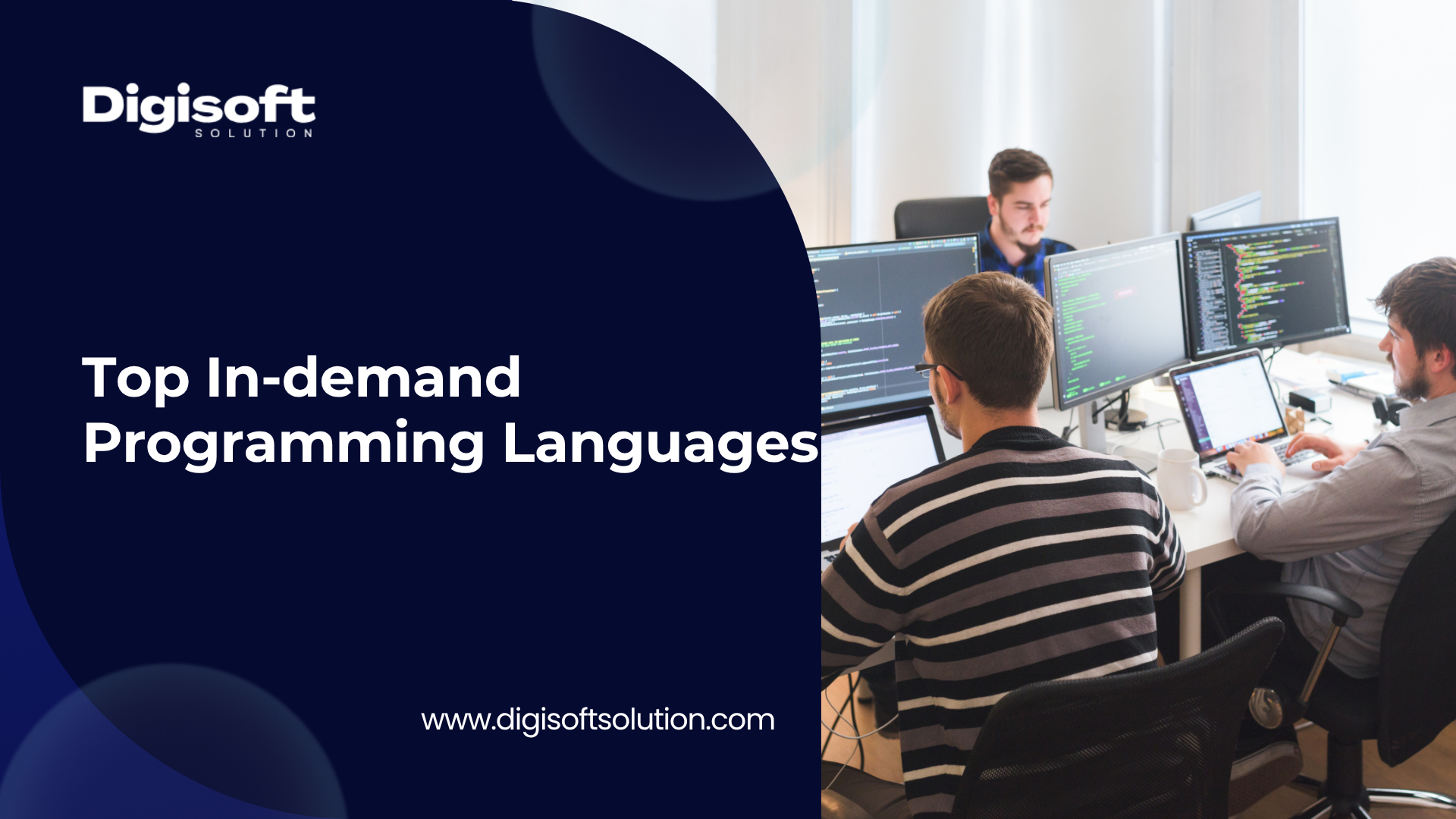
If you have been trying to figure out which programming language is actually worth learning or investing in right now, you are not alone. Every year, dozens of articles throw around rankings without really explaining what drives them. Most of them just copy the TIOBE Index or the Stack Overflow Developer Survey and call it a day.
We are not doing that.
At Digisoft Solution, we have spent over 13 years building software products for clients across the US, UK, UAE and beyond. We work with Python developers, JavaScript engineers, Java architects, and more, every single month. So when we talk about which languages are in-demand, we are talking from actual hiring experience, not just trend reports.
This article covers the top 10 most in-demand programming languages in 2026, what each one is actually used for, what it costs to hire a developer skilled in it, and how to think about which one fits your project. We also added a cost analysis section because, honestly, most articles skip that entirely and just say "it depends." That is not useful.
What Does "In-Demand" Actually Mean in 2026?
There is a difference between a language being popular and a language being in-demand. A language can have millions of hobbyist users but zero enterprise hiring. For this article, in-demand means three things:
- Active job postings across tech, finance, healthcare and retail sectors
- Real usage in production systems, not just side projects or tutorials
- Growing or stable salary benchmarks, which signals employer willingness to pay
With that filter in place, here is what the 2026 landscape actually looks like.
How We Ranked These Languages
We cross-referenced data from GitHub's 2025 Octoverse, the Stack Overflow Developer Survey 2025, TIOBE Index, RedMonk rankings, and real job posting analysis from BridgeView IT (updated March 2026). Where salary data is cited, we used Glassdoor, ZipRecruiter, and Indeed data from early 2026.
1. Python: The Undisputed Leader in AI and Data
Why Python Dominates in 2026
Python has been at the top for a while now and it is not slowing down. In the November 2025 TIOBE Index, Python held over 23% share, which is a bigger lead over the second-place language than at any previous point. That is not a coincidence. The explosion of AI, machine learning, and data science work has pushed Python into every boardroom conversation.
About 51% of developers cite Python as their most preferred language according to survey data. And approximately 45.7% of tech recruiters worldwide are actively screening for Python skills, making it the single most recruited-for language in the 2025-2026 hiring cycle.
What Python is Actually Used For
- Machine learning and AI model development (TensorFlow, PyTorch, scikit-learn)
- Data pipelines and analytics (Pandas, NumPy, Apache Spark integrations)
- Backend web development (Django, FastAPI, Flask)
- Automation scripts and DevOps tooling
- Scientific computing and financial modeling
Cost of Hiring a Python Developer in 2026
Here is where most articles get lazy. They say "Python developers cost between $50 and $150 per hour" and move on. Let's be more precise about this.
|
Experience Level |
US In-House Annual Salary |
US Freelance Hourly |
Dedicated Offshore (Digisoft) |
|
Junior (0-2 yrs) |
$91,000 - $100,000 |
$25 - $45/hr |
From $1,500/mo |
|
Mid-Level (3-5 yrs) |
$125,000 - $143,000 |
$45 - $70/hr |
From $2,500/mo |
|
Senior (6+ yrs) |
$150,000 - $172,000 |
$70 - $100/hr |
From $3,000/mo |
The US in-house salary data reflects Glassdoor median total compensation of $129,000 as of May 2026 and ZipRecruiter averages from the same period. When you factor in payroll taxes (roughly 7.65% employer FICA), benefits (typically 20-30% on top of base), paid time off, and onboarding overhead, a $130,000/year Python developer actually costs a US company closer to $180,000-$200,000 annually in total employer spend.
That is why many product teams are shifting to dedicated developer engagement models, which eliminate those overhead costs while providing the same skill level.
Case Study: AI Platform for Veridian Urban Systems
One of our recent engagements involved building an AI-driven urban intelligence platform for Veridian Urban Systems. The client needed real-time dashboards, KPI tracking, and predictive city analytics. We deployed a dedicated Python backend team using FastAPI and scikit-learn. The result was a system that delivered city insights 42% faster than their previous manual reporting process. The entire engagement was handled at a fraction of what a comparable US-based team would have cost.
2. JavaScript: Still the King of the Web
Why JavaScript is Non-Negotiable
JavaScript is the only programming language that runs natively in every web browser on the planet. That single fact makes it impossible to replace, regardless of how many newer languages emerge. It has topped developer surveys for over a decade and continues to do so in 2026.
Companies like Amazon, Microsoft, Google and PayPal all depend heavily on JavaScript for their front-end interfaces, cloud-based tools and API services. It is the backbone of modern web experiences.
What JavaScript is Actually Used For
- Front-end interfaces and interactive web applications (React, Vue, Angular)
- Backend services via Node.js
- Cross-platform mobile development (React Native)
- Serverless functions and cloud microservices
- Real-time applications like chat, live dashboards and collaborative tools
The TypeScript Shift
One of the biggest stories of 2025 was TypeScript surpassing both Python and JavaScript to become the number one language on GitHub by contributor count. This is significant. It tells you that the industry is moving toward strongly-typed JavaScript for large-scale applications. If your team is building anything beyond a simple website, TypeScript is now the expected standard, not an optional upgrade.
Our web application development team works in both JavaScript and TypeScript, picking the right tool based on project scale and team size.
3. Java: The Enterprise Backbone That Refuses to Retire
Why Java Still Powers the World
Every few years someone writes an article declaring Java dead. Then you look at actual hiring data and Java keeps appearing at the top. In 2026, Java remains the dominant language for enterprise software, banking systems, large-scale backend services and Android development.
The reason is simple. Java runs on the JVM (Java Virtual Machine), which means it runs everywhere with consistent performance. Banking institutions, insurance companies, government agencies and logistics platforms have billions of lines of Java code in production. They are not rewriting those systems in Rust or Go anytime soon.
What Java is Actually Used For
- Enterprise application servers (Spring Boot, Quarkus, Micronaut)
- Android mobile applications
- High-frequency trading and financial platforms
- Large-scale distributed systems (Apache Kafka, Apache Hadoop)
- Government and healthcare backend systems
We offer specialized backend development services with experienced Java architects who understand both legacy modernization and greenfield enterprise builds.
4. TypeScript: JavaScript, But Production-Ready
Why TypeScript is Everywhere in 2026
TypeScript is essentially JavaScript with strict typing added on top. It compiles down to regular JavaScript, so it runs anywhere JavaScript runs. But the addition of static type checking catches bugs at compile time rather than runtime, which matters enormously in large codebases with multiple developers.
The 2025 GitHub Octoverse data confirmed TypeScript as the most contributed-to language on the platform, surpassing JavaScript. C# 14, released with .NET 10 in April 2025, brought similar improvements to the Microsoft ecosystem. These trends are converging: the industry wants type safety, and TypeScript delivers that for web development.
- Best for: Large web applications, API development, team-based frontend projects
- Key frameworks: NestJS, Next.js, Angular
- Adoption signal: Used by Airbnb, Slack, Asana as primary frontend language
5. Go (Golang): Built for Cloud-Native Performance
Why Go is a Top-5 Language in 2026
Go was designed by engineers at Google specifically for the problems modern cloud infrastructure creates: high concurrency, fast compile times, and simple deployment. It produces statically compiled binaries that are fast, small and easy to containerize. That is exactly what cloud-native and microservices architectures need.
According to BridgeView IT's 2026 job posting analysis, Go is now firmly in the top five in-demand languages for US tech roles, particularly in cloud infrastructure, DevOps tooling and API services. Companies like Cloudflare, Uber and Docker built core infrastructure in Go.
- Best for: Microservices, CLI tools, high-concurrency backends, Kubernetes operators
- Why it beats alternatives: Go's goroutines handle concurrency far more elegantly than threads in Java or callbacks in Node.js
- Salary signal: Go developers command a premium, typically 10-15% above Python and Java equivalents
If you are building cloud application development with serious performance requirements, Go is worth serious consideration.
6. SQL: The Language That Has Outlasted Every "Database Revolution"
Why SQL Belongs on This List
SQL is not a general purpose programming language in the traditional sense but leaving it off this list would be dishonest. Every single application that handles data uses SQL or a dialect of it. Whether you are running PostgreSQL, MySQL, Microsoft SQL Server, or querying BigQuery and Redshift on the cloud, you are writing SQL.
BridgeView IT's 2026 analysis specifically listed SQL as one of the five most practical skills for job security because data problems do not disappear even when broader market conditions tighten. Every backend developer, data analyst, data engineer and business intelligence professional needs SQL. Period.
- It is required in virtually every backend and data role
- Modern variants like window functions, CTEs and JSON querying keep it relevant for complex analytics
- NoSQL never replaced it. It just joined it.
7. Rust: The Safety-First Systems Language Taking Over
Why Rust Is Rising Fast
Rust is the programming language that developers love most, according to the Stack Overflow Developer Survey for multiple years running. That level of developer satisfaction is unusual and it reflects something real: Rust solves memory safety problems at compile time without needing a garbage collector, which means you get C/C++ performance without C/C++ memory bugs.
The US government's CISA (Cybersecurity and Infrastructure Security Agency) formally recommended Rust as a memory-safe language for new systems software development. Microsoft is rewriting parts of Windows in Rust. The Linux kernel now accepts Rust contributions. These are not hobbyist endorsements.
- Best for: Systems programming, WebAssembly, game engines, security-critical softwar
- Industries adopting it: Finance, defense, automotive, cloud infrastructure
- Hiring reality: Rust developers are scarce, which means they command significant salary premiums
8. Kotlin: The Modern Android Language
Why Kotlin Has Displaced Java on Android
Google officially declared Kotlin the preferred language for Android development back in 2019 and the ecosystem has fully made the transition. New Android projects started in 2026 almost universally use Kotlin. Kotlin is fully interoperable with Java, runs on the JVM, and offers a more concise and safer syntax.
- Best for: Android mobile development, server-side JVM applications
- Kotlin Multiplatform is gaining traction for sharing code between Android and iOS
- Spring Boot now has first-class Kotlin support for backend development
We build native Android applications using Kotlin as part of our Android app development service. Our team has shipped Kotlin apps for clients in healthcare, on-demand services and fintech.
Case Study: Real-Time Barber Booking Platform (IHLAQ)
A real-world example of what Kotlin can do at scale: we built a barber booking marketplace in Qatar that handles over 5,000 peak daily bookings. The Android app was built in Kotlin, with conflict-free scheduling logic, hybrid home and salon service support, and full bilingual Arabic RTL support. It is the kind of project that exposes the real capabilities of the language.
9. Swift: Apple's Answer to Safer iOS Development
Why Swift Matters in the Mobile Economy
Swift is Apple's official language for iOS, macOS, watchOS and tvOS development. Apple released Swift in 2014 to replace Objective-C and the migration is now essentially complete. Any new iOS application built in 2026 is built in Swift.
Given that Apple's App Store generates more revenue per user than Google Play, and given that enterprise mobile applications frequently prioritize iOS first, Swift expertise carries real business value. The language is designed to be fast (it is often faster than Objective-C in benchmarks) and safe (it eliminates entire classes of memory bugs).
- Best for: iOS apps, macOS software, server-side Swift with Vapor framework
- SwiftUI is rapidly replacing UIKit for new interface development
- Demand is concentrated in North American and European markets where iOS market share is highest
Our iOS application development team builds production-grade Swift apps for clients in healthcare, retail and logistics.
10. PHP: The Language That Still Powers 77% of the Web
Why PHP Still Deserves a Spot in 2026
Mentioning PHP often gets an eye roll from developers who associate it with messy 2008-era code. That is a fair historical critique. But here is the reality: PHP still powers roughly 77% of all websites with a known server-side language, including WordPress, which alone runs about 43% of the entire web.
Modern PHP (version 8.x) is a genuinely good language. It has JIT compilation, strong typing, named arguments, fibers for asynchronous programming and a mature ecosystem. Laravel, the most popular PHP framework, ranks consistently as one of the most elegant and productive backend frameworks in any language.
- Best for: CMS-driven websites, e-commerce platforms (WooCommerce, Magento), SaaS backends with Laravel
- Laravel's ecosystem includes Livewire, Inertia.js and Octane, making it competitive with Node.js for many use cases
- Hiring reality: PHP/Laravel developers are abundant and cost-effective compared to Python or Go talent
We regularly hire WordPress developers and Laravel engineers for clients who want fast, maintainable web platforms without the cost of exotic tech stacks.
Programming Language Developer Cost Comparison (2026)
Here is the complete cost picture across all ten languages. US in-house cost reflects total employer spend (salary plus benefits, taxes and overhead), not just base salary. Dedicated offshore rates reflect Digisoft Solution's published pricing model with no platform fees.
|
Language |
US In-House Total Cost/yr |
US Freelance Rate/hr |
Dedicated Offshore/mo |
Talent Availability |
|
Python |
$180,000 - $220,000 |
$45 - $100/hr |
From $2,500 |
High |
|
JavaScript / TypeScript |
$160,000 - $210,000 |
$40 - $90/hr |
From $2,000 |
Very High |
|
Java |
$175,000 - $230,000 |
$50 - $110/hr |
From $2,500 |
High |
|
Go (Golang) |
$185,000 - $240,000 |
$60 - $120/hr |
From $3,000 |
Medium |
|
Rust |
$190,000 - $260,000 |
$70 - $130/hr |
From $3,000 |
Low |
|
SQL |
Bundled with backend roles |
$30 - $80/hr |
Included with backend |
Very High |
|
Kotlin |
$170,000 - $220,000 |
$50 - $100/hr |
From $2,500 |
Medium-High |
|
Swift |
$175,000 - $225,000 |
$55 - $110/hr |
From $2,500 |
Medium |
|
PHP / Laravel |
$130,000 - $170,000 |
$30 - $75/hr |
From $1,500 |
Very High |
|
C# / .NET |
$165,000 - $220,000 |
$45 - $95/hr |
From $2,500 |
High |
Note: US in-house total cost includes base salary, employer-side payroll taxes (7.65% FICA), health insurance contribution (typically $8,000-$15,000/yr per employee), paid leave, and onboarding overhead. For a $130,000 salary, the real employer cost is often $180,000-$200,000 when everything is accounted for. Many articles quote only base salary, which significantly understates the true cost of in-house hiring.
Is Dedicated Offshore Development Actually Good Value?
This is a fair question and it deserves a straight answer, not a vague disclaimer.
The honest answer is: it depends on what you are buying. A $2,500/month dedicated developer is not a junior PHP developer doing copy-paste work. At Digisoft Solution, our mid-level developers have 4-7 years of production experience, participate in daily standups, use your project management tools, and operate on your timezone schedule. There are no platform fees, no bidding wars, and no surprise invoices.
Compare that to a US mid-level Python developer at $143,000 base salary. With employer overhead, you are spending roughly $195,000 per year, or about $16,250 per month. A dedicated offshore developer at $2,500-$3,000 per month provides roughly 80-85% of the same technical capability for about 18% of the cost. The 15-20% gap is real and it primarily shows up in domain knowledge depth and communication overhead in the first 2-4 weeks.
For most product companies and growing startups, that tradeoff is very much worth it. For specialized low-latency trading systems or classified government work, it may not be. Knowing the difference is what separates good technical decision-making from cost-cutting that comes back to bite you.
If you want to understand what this actually looks like in practice, our case studies cover real engagements across fintech, healthcare, logistics and AI where dedicated teams delivered production systems at a fraction of in-house cost.
How to Choose the Right Programming Language for Your Project
Start With the Problem, Not the Trend
The biggest mistake companies make is chasing trending languages rather than matching the language to the problem. Here is a simple decision framework.
|
Your Primary Need |
Best Language Choice |
Why |
|
AI / ML / Data Science |
Python |
Unmatched ecosystem (PyTorch, TensorFlow, Pandas) |
|
Web Frontend / Full-Stack |
JavaScript + TypeScript |
Only choice that runs in the browser natively |
|
Enterprise Backend / Fintech |
Java or C# |
Proven at scale, huge talent pool, mature frameworks |
|
Cloud-Native / Microservices |
Go |
Built for concurrency and container-friendly deployment |
|
Android Mobile |
Kotlin |
Google's official preferred language since 2019 |
|
iOS Mobile |
Swift |
Apple's official language, required for new App Store submissions |
|
E-Commerce / CMS |
PHP (Laravel or WordPress) |
Mature ecosystem, massive talent pool, cost-effective |
|
Systems / Security Software |
Rust |
Memory safety without GC, government-recommended |
|
Data Querying / BI |
SQL |
No substitute exists for relational and warehouse queries |
Languages Worth Mentioning: What Is Declining and Why
Not every language ages gracefully. Here is an honest assessment of what is losing ground in 2026 and why it matters for hiring decisions.
- Perl: Once the go-to for text processing and scripting. Now almost entirely replaced by Python. Hiring Perl developers is genuinely difficult and the talent pool is aging.
- ColdFusion: Still running in some legacy enterprise systems. Should not be the basis of any new development.
- VBA (Visual Basic for Applications): Still very common in Excel-heavy finance workflows but being gradually displaced by Python and Power Query integrations.
- Ruby on Rails: Still a good framework but developer interest has declined steadily. It powered Twitter and GitHub in their early days, but both eventually moved on.
If you are maintaining legacy systems in any of these, that is one thing. Starting new projects in them in 2026 would be a mistake that your future engineering team will not thank you for.
The Real Cost of Picking the Wrong Language
We have seen this firsthand. A healthcare client came to us after spending 18 months building a patient data platform in Ruby on Rails with a small US-based team. The system worked. But when they needed to scale from 10,000 to 500,000 users, the framework's architecture made horizontal scaling unnecessarily painful. They ended up rewriting the core service layer in Go.
That rewrite cost them roughly $280,000 and six months of engineering time. A conversation at the start of the project about language selection based on scale requirements would have cost nothing.
We offer a free consultation and development roadmap session. If you are unsure which stack fits your requirements, book a session before you write a single line of code.
Frequently Asked Questions
Which programming language is best to learn in 2026 for job security?
Python and Java offer the broadest job security because they appear across almost every industry. SQL is arguably the most durable skill in tech because every application that stores data needs someone who can query it well. If you are choosing just one language to learn for employability, Python gives you the most doors to walk through.
Is JavaScript still relevant in 2026?
Absolutely. JavaScript runs in every browser on every device. That is not changing. TypeScript is now the preferred form of JavaScript for production applications, so learning TypeScript alongside JavaScript is the right move for 2026.
What is the most expensive programming language skill to hire for?
Rust and Go developers command the highest premiums in the US market in 2026 because the supply of experienced engineers is smaller relative to demand. A senior Rust developer in the US can command $160,000-$200,000+ in total compensation, and they are still difficult to find.
How much does it cost to hire a dedicated developer compared to a freelancer?
A dedicated developer on a monthly engagement model typically costs less than a freelancer over a 3-month period and significantly less than a full-time in-house hire. The main difference is continuity. A freelancer may juggle multiple clients. A dedicated developer is fully allocated to your project during the engagement period.
Does Digisoft Solution provide developers skilled in all 10 of these languages?
Yes. We have active teams working in Python, JavaScript, TypeScript, Java, PHP/Laravel, Kotlin, Swift and .NET/C#. For Rust and Go projects, we can discuss requirements and build out a specialized team. You can review our services and hire options below.
Final Thoughts: What This Means for Your Business
The programming language landscape in 2026 is not chaotic. It is actually pretty clear if you filter out the noise. Python dominates AI and data. JavaScript and TypeScript own the web. Java and C# anchor enterprise systems. Go and Rust are winning cloud infrastructure and systems programming. Kotlin and Swift handle mobile. PHP/Laravel remains extremely cost-effective for web platforms.
What changes year to year is not the languages themselves but the contexts where they get applied. The rise of AI workloads has pulled Python into places it was not before. The shift to cloud-native architecture has pushed Go and Rust up the priority list. TypeScript has replaced plain JavaScript in any serious codebase.
If you are a business deciding on a tech stack, match the language to the problem, think about the total cost of the talent you need to hire, and consider whether a dedicated development engagement gives you a better risk-adjusted outcome than building an in-house team from scratch.
Explore our software development services or reach out directly if you want a frank conversation about which stack makes sense for your project. We have seen enough of them to give you a straight answer.
You can also explore how we approach UI/UX design and
Digital Transform with Us
Please feel free to share your thoughts and we can discuss it over a cup of coffee.