Jake's Landscaping: Turning Clicks into Clients









About The Client
Jake's Landscaping
- IndustryLandscaping & Gardening Services
- RegionNewcastle, Australia
- PlatformService-Based Website (WordPress)
- Delivery2 Months
Jake’s Landscaping is a Newcastle-based residential service provider. It delivers lawn care, hedge trimming, garden cleanups, paving, and green waste removal across multiple suburbs within a defined service area. Services are delivered on a one-time or recurring schedule.
The business operates on an optimized scheduling system where job allocation depends on service type, availability, and location. Each request includes dynamic inputs such as site conditions, scope, and timing, requiring well-defined data capture for accurate operations.
This workflow required standardization to reduce inconsistencies in job intake, which had been managed manually.
Project Overview
From Unstructured Inquiries To Complete Quote Requests
Before implementation, customers contacted Jake’s Landscaping through unstructured inquiries, often by phone or message. This resulted in incomplete project details and required multiple follow-ups to clarify requirements.
After implementation, users were guided through a clear, optimized flow. It guides users to submit a complete quote request with all relevant project details.
Jake’s Landscaping collaborated with Digisoft Solution to develop a platform that simplifies this process while maintaining clarity across services. Each service section is linked to an optimized form that captures key inputs, including service type, schedule, location, and attachments.
Built on WordPress, the site uses modular components for easy updates and ensures consistent, well-defined handling of submitted leads.
The Concept
Problem-Based Journeys With Consistent Data Capture
The concept is based on user problems rather than service categories. Instead of generic listings, the system uses a problem-based structure, such as overgrown lawns, time constraints, safety concerns, or upcoming events. This allows users to quickly match needs with services.
The information flow follows problem identification, supporting visuals, and a defined action path. Each service is linked to specific form groups, ensuring consistent data capture and reducing decision time.
Built on WordPress with modular components, the experience stays easy to update while every submission follows the same structured schema.

Key Challenges Addressed
Design Fidelity, Forms & Cross-Device Consistency
Static Design to Functional Layout Conversion
Converting PDF-based design references into a functional web layout while preserving spacing, alignment, and visual hierarchy across all pages. The implementation ensured design fidelity and prevented layout inconsistencies in the live system.
Service Content Structuring
Multiple service types were organized into clearly defined sections with consistent layout behavior. This ensured predictable rendering while keeping the structure flexible for future content updates.
Optimized Quote Request System
The form system was designed with an optimized schema to handle fields such as service type, schedule, location, and attachments. Strict field mapping and validation were required to prevent incomplete or inconsistent submissions.
Data Consistency and Storage
User inputs were captured in a standardized format to ensure reliable storage and future usability. This prevented data inconsistency issues that could affect processing and system reliability.
Future Integration Readiness
The data model and form outputs were designed to support future integration with external lead management systems. This ensured compatibility without requiring changes to core form logic.
Layout and Component Flexibility
Reusable components were built beyond template constraints to maintain consistent behavior across pages. This allowed scalable content variations without breaking the layout structure.
Cross-Device Rendering
Consistent layout behavior and form usability were ensured across mobile, tablet, and desktop devices. Adaptive handling was applied for spacing, inputs, and interaction patterns.
Performance and Load Handling
Asset optimization and controlled script loading were implemented to maintain acceptable load times. This ensured stable performance across varying network conditions and devices.
Technical Solutions Implemented
Elementor, Gravity Forms & Standardized Lead Handling
Component-based layouts, a defined form system, and disciplined storage keep every inquiry complete, export-ready, and ready for future CRM connections.
Component-Based Design Implementation
The website was built using Elementor with a component-based structure. This enables reusable design modules that maintain consistent spacing, alignment, and visual hierarchy across all pages.
Standardized Content Architecture
Service pages follow a standardized layout and content schema. This ensures predictable rendering and allows new services to be added without affecting the existing structure.
Defined Form System
Gravity Forms was configured to capture organized inputs, including service type, schedule, location, attachments, and user details. This ensures consistent field mapping across submissions.
Validation And Submission Logic
Validation rules enforce required fields and prevent incomplete submissions
Data Storage Model
Form submissions are stored in the WordPress database, enabling centralized access and consistent data retrieval.
Streamlines Inquiry-to-Follow-up Flow
Submissions flow through validation, CMS storage, admin access, and export-ready formatting for external systems.
CRM-Ready Integration (No Structural Changes Needed)
The data model is kept consistent and optimized to support future integration with CRM or lead management systems without modifying core form logic.
Responsive Layout System
Custom layout controls ensure consistent rendering across mobile, tablet, and desktop devices, handled at the component level rather than fixed templates.
Performance Optimization
Assets and page elements were optimized to reduce load time and ensure stable performance across varying devices and network conditions.
This delivery replaced fragmented inquiries with a structured quote system that improves response efficiency, lead quality, and long-term maintainability on WordPress.
Why This Architecture Works
Structured Intake With WordPress Modularity
Pairing Elementor components with Gravity Forms creates repeatable sections, predictable validation, and storage that stays consistent even as services grow.
- Problem-first content paths reduce decision time before users reach a form
- Each service maps to defined field groups for repeatable data capture
- Validation blocks incomplete submissions before they reach operations
- Centralized WordPress storage keeps exports and follow-ups straightforward
- Outputs remain CRM-ready without rewriting core form logic
- Performance-oriented asset handling supports mobile-heavy traffic
The result is a conversion-focused residential site that turns browsers into qualified, detail-rich quote requests.
Screens From the Live Build
Surfaces We Designed & Launched For Local Demand
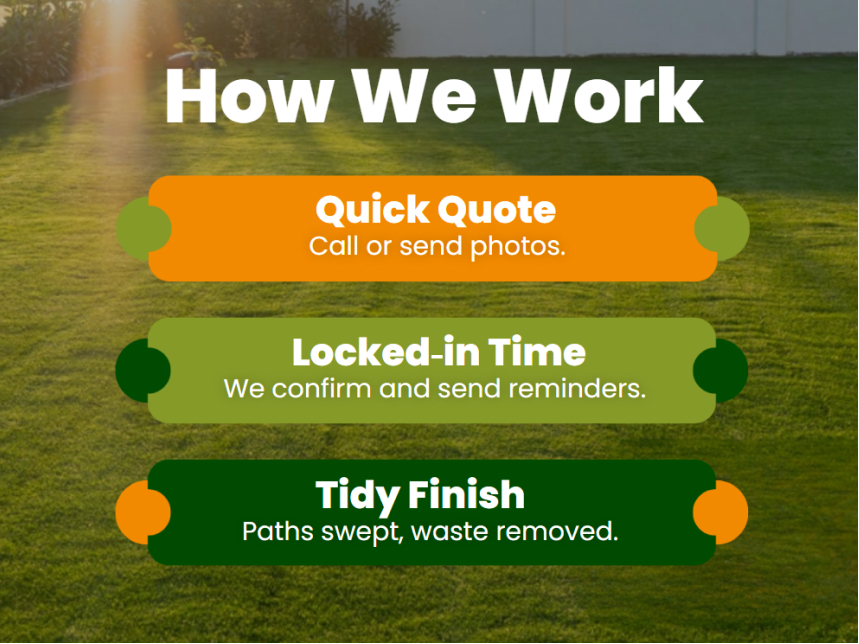
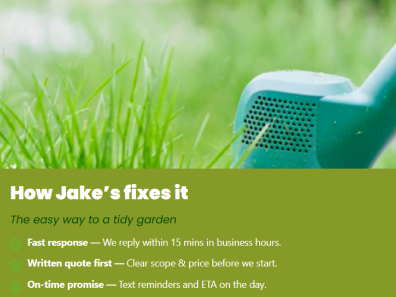
Highlights from the shipped Jake's Landscaping experience—service storytelling, quote access points, social proof, and local relevance across Newcastle suburbs.




Core Features & Functional Capabilities
Built For Trust, Clarity & Local Reach
- Service Showcase Pages: Each service is presented in a structured format with clear descriptions, scope, and visual support, enabling users to quickly understand the available offerings.
- Quote Request Access Points: Quote requests are accessible from multiple site entry points across the website, allowing seamless movement from service browsing to inquiry submission.
- Testimonials Display: Client feedback is presented in a consistent, readable format that helps build trust and supports decision-making during service selection.
- Before & After Gallery: Project outcomes are displayed through optimized image comparisons, allowing users to assess service quality and results visually.
- Local Service Visibility Structure: Content is organized to reflect service areas and location relevance, helping users quickly identify availability in their region.
- Guided Navigation Flow: We optimized the website to guide users from service discovery to inquiry submission through clear pathways and call-to-action placements.
- Cross-Device Accessibility: The experience is consistent across mobile, tablet, and desktop, ensuring usability and readability regardless of device type.
Technologies and Tech Stack We Used
Tools Chosen For Leads, SEO & Reliability
WordPress
Flexible publishing foundation with modular updates.
Custom Theme Structure
Brand-aligned layouts with room to grow.
Elementor
Reusable components for consistent spacing and hierarchy.
Gravity Forms · Contact Form 7
Structured intake with mapped fields and validation.
Yoast SEO
On-page guidance for local visibility.
WP Rocket
Caching and delivery tuning for faster loads.
Wordfence Security
Hardening and monitoring for production traffic.
UpdraftPlus
Scheduled backups for operational peace of mind.
Testing & Quality Assurance
Validated For Forms, Responsiveness & Integrity
We verified layout, validation paths, and real-device behavior before launch.
- Verified layout, spacing, navigation flow, and content consistency
- Tested form validation, error handling, and failure scenarios (invalid inputs, timeouts, duplicate submissions)
- Confirmed secure storage and retrieval of submitted data
- Tested responsiveness across 320px, 768px, 1024px, and 1440px breakpoints
- Validated cross-browser compatibility (Chrome, Safari, Firefox, Edge)
- Evaluated performance, image rendering, and overall content integrity
Our Approach & Development Timeline
Structured Delivery Across 2 Months
We completed the project in over 2 months, following a structured development process.
Requirement Review & Planning
Discovery, IA, and acceptance criteria for forms and services.
Layout Implementation
Elementor components, templates, and responsive behaviors.
Form Setup & Content Integration
Gravity Forms mapping, attachments, and on-page copy.
Testing & Adjustments
QA cycles, performance passes, and refinements.
Final Review & Deployment
Launch readiness, monitoring, and handover.
Measurable Outcomes
Analytics, Forms & Operational Efficiency
Metrics based on GA4 analytics, form submissions, and server-side lead tracking within a 60–90 day post-launch evaluation window, benchmarked against the pre-launch baseline:
Increase in quote requests compared to pre-launch baseline
Improvement in inquiry completion over the previous period
Reduction in follow-up communication tracked via CRM
Faster response handling based on lead-time comparison
Increase in service page engagement measured via GA4 events
Traffic from targeted local regions based on analytics data
Mobile usage recorded across all sessions
This project redefined how Jake’s Landscaping captures leads by replacing fragmented inquiries with a structured quote system that improves response efficiency and lead quality.